

Habakkuk - Bible Map Collection
Original price was: $19.00.$10.00Current price is: $10.00.
Habakkuk Asks God, “Why Are You Letting This Happen?”
Habakkuk looks at the violence and corruption spreading through Judah and asks why God is doing nothing. God’s answer shocks him: Babylon is coming, and the cure will look even worse than the disease.
This Bible map collection helps readers follow Habakkuk’s world of Judah, Jerusalem, Babylon, Edom, invasion routes, collapsing kingdoms, and a prophet trying to trust God when nothing happening around him makes sense.
Description
Why Habakkuk Matters
Habakkuk is the prophet who asks God the question many religious people are afraid to say out loud:
“Why are you letting this happen?”
He looks around Judah and sees violence, destruction, arguments, corruption, and injustice. The law is still there, but no one powerful seems interested in obeying it. Judges twist justice. Wicked people surround good people. The country is coming apart.
Habakkuk complains that there is more lawlessness than the law can handle:
“There’s too much of it for the law to handle” (Habakkuk 1:4).
He wants God to do something.
Then God answers.
The answer is worse than Habakkuk expected.
God says he is bringing the Babylonians.
Babylon is the rising superpower of the ancient Middle East. Its armies move quickly. Its soldiers laugh at fortified cities. They pile up dirt ramps, climb over walls, and carry conquered people away from home.
Habakkuk describes them like a storm blowing in from the desert:
“The army comes to hurt and to kill.
They blow in like a desert storm” (Habakkuk 1:9).
Habakkuk asked God to stop the violence in Judah. God says he will do it by sending an army far more violent than Judah.
That does not make sense to the prophet.
So Habakkuk asks another question.
How can God use people worse than the people he is punishing?
“Why on earth would you tolerate these intolerable people?
How can you side with the bad guys,
Letting them kill people better than they are?” (Habakkuk 1:13).
This is what makes Habakkuk unusual.
Most prophets deliver God’s message to the people. Habakkuk spends much of his book arguing with God.
He complains. God answers. Habakkuk objects. God answers again.
The book reads almost like a play, with the prophet and God speaking back and forth while Babylon’s army gets closer.
God tells Habakkuk that Babylon will not escape judgment.
The Babylonians may conquer nations, steal land, loot cities, enslave survivors, and build an empire with blood. But they will eventually answer for what they have done.
God gives Habakkuk a series of taunts against the empire.
You stole from other nations. They will steal from you.
You destroyed cities. Your cities will fall.
You humiliated people. You will be humiliated.
You built your power with violence. Violence will destroy you.
Babylon’s success is temporary.
But God does not promise that Judah will avoid the invasion. He does not tell Habakkuk everything will work out quickly. He tells the prophet to wait.
That may be the hardest answer in the book.
God says the message concerns something that will happen at the right time. It may seem slow, but it is coming. Babylon will fall. Justice will come.
Just not yet.
Then God says:
“Good people will live because of their devotion” (Habakkuk 2:4).
Other Bible translations use words such as “faith” or “faithfulness.”
The apostle Paul later quoted this verse while explaining that people are made right with God through faith. Centuries after that, the verse became important to Martin Luther and the Protestant Reformation.
But inside Habakkuk’s story, the verse is not an abstract religious slogan.
It is survival advice.
Babylon is coming. Jerusalem may fall. Crops may disappear. Livestock may be stolen. Families may lose homes, land, and people they love.
Habakkuk cannot stop the invasion.
He can decide whether he will keep trusting God.
By the end of the book, Habakkuk has changed.
His questions have not all been answered. Babylon is still coming. Judah still faces disaster. But the prophet has decided that his faith will not depend on a good harvest, a strong economy, national security, or a peaceful future.
He imagines the worst:
No figs.
No grapes.
No olives.
No grain.
No sheep.
No cattle.
Then he says:
“What will I do?
I will thank God that he is my Savior.
He gives me the strength to go on.
He gives me the sure-footed speed of a deer,
And to higher ground he leads on” (Habakkuk 3:17–19).
Habakkuk does not say suffering is good. He does not pretend the losses do not matter. He does not claim that faithful people never feel frightened or confused.
He says he will trust God even when everything he depended on is gone.
That is why Habakkuk matters.
The book gives people permission to question God without walking away from him. Habakkuk is blunt, frustrated, and sometimes bewildered. God does not strike him down for asking hard questions.
The prophet begins by demanding, “Why aren’t you doing something?”
He ends by saying, “Even when I do not understand what you are doing, I will still trust you.”
Maps for Teaching Habakkuk
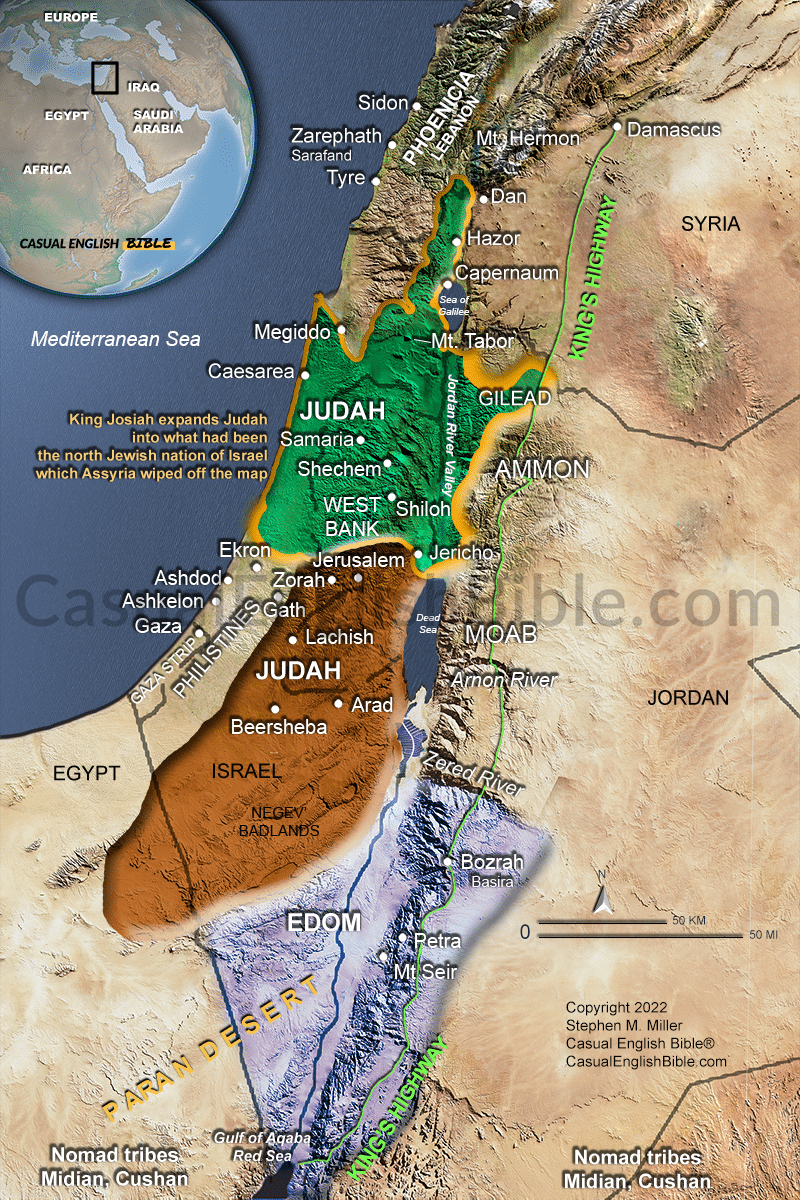
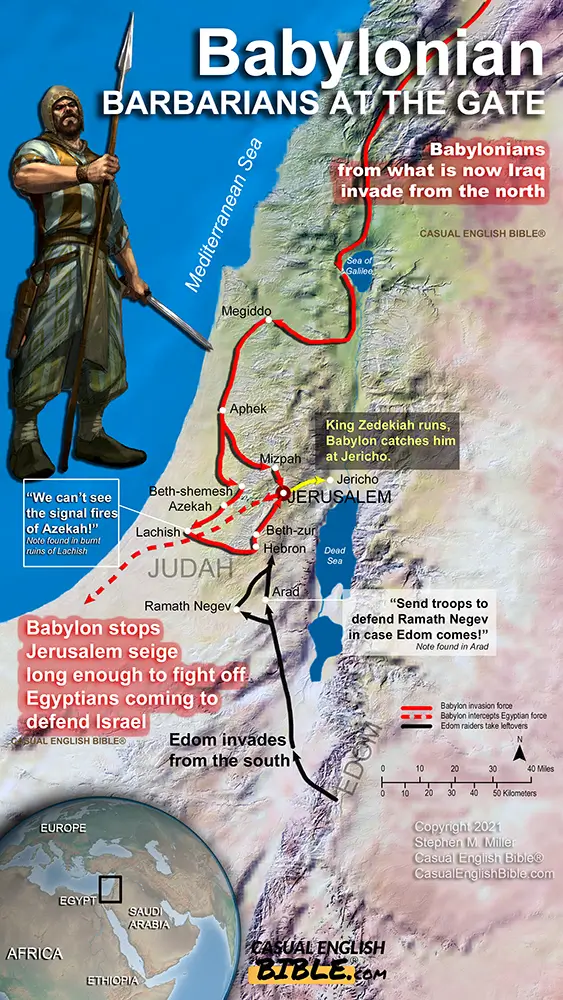
This Bible map collection gives readers geographic and historical context for Habakkuk, including Judah, Jerusalem, Babylon, Edom, the ancient kingdoms surrounding Judah, the Babylonian Empire, and the invasion routes armies used to reach the Promised Land.
The maps help teachers and students visualize Habakkuk’s world: a small kingdom weakened by corruption, a Babylonian army approaching from the east and north, neighboring nations watching Judah collapse, and a prophet trying to understand how God could use one violent nation to punish another.
The collection includes six high-resolution maps presented across 14 downloadable PDF pages.
It is designed for pastors, Bible teachers, small groups, Sunday school classes, homeschool families, and readers who want help teaching Habakkuk with clear maps, historical context, and plain-English visual support.
Habakkuk Bible Map Collection
- Maps: 6 high-resolution Bible maps in 3D style
- Instant PDF download
- Optional licensing available for broader use
The product includes two files for immediate download:
📱 Maps optimized for use in mobile devices; file size 4 MB
🖥️ Maps in higher resolution, 11 MB
Click to view all maps in the Habakkuk Bible Map Collection
Habakkuk Bible Atlas
The Complete Bible Map Library
- 1,000+ Bible maps
Many in immersive 3D-style terrain so you can visualize the land, not just read about it - 1,298 pages
A massive, chapter-by-chapter visual companion to the Bible - Two versions included
- 📱 Mobile-optimized (157 MB) — fast, smooth, and easy to use on phones & tablets
- 🖥️ Full-resolution (1.2 GB) — maximum detail for deep study and large screens
- Covers the entire Bible
Every book with meaningful geography—from Genesis to Revelation
SALE Original price was: $80.00.$75.00Current price is: $75.00.