
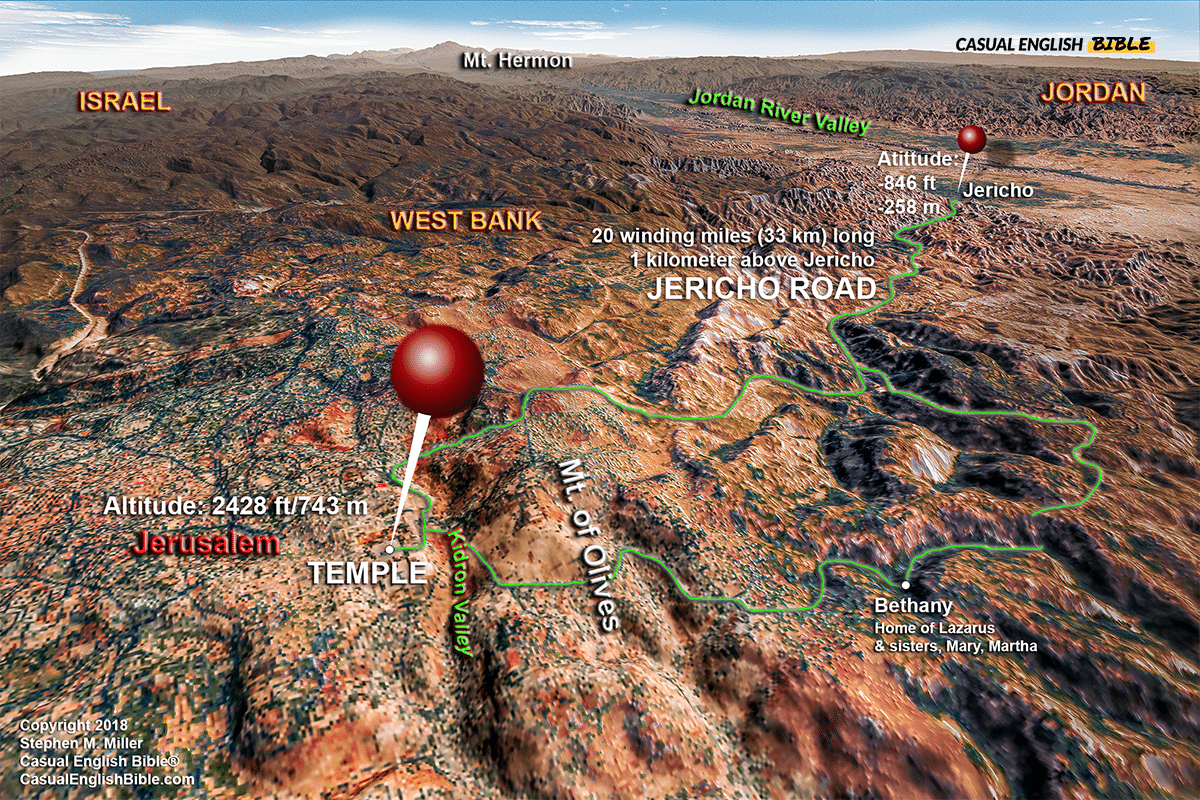
Malachi – Bible Map Collection
Original price was: $19.00.$10.00Current price is: $10.00.
Malachi Tells Judah, “Stop Giving God Your Leftovers”
The temple is rebuilt. Animal sacrifices have started again. The Jewish people are back in their homeland after getting erased from the world’s political map and deported to what is now Iraq.
But priests are accepting diseased animals, people are withholding their tithes, husbands are betraying their wives, and worshipers are starting to wonder whether serving God is worth the trouble.
Malachi says God is not fooled by religious activity that costs people nothing.
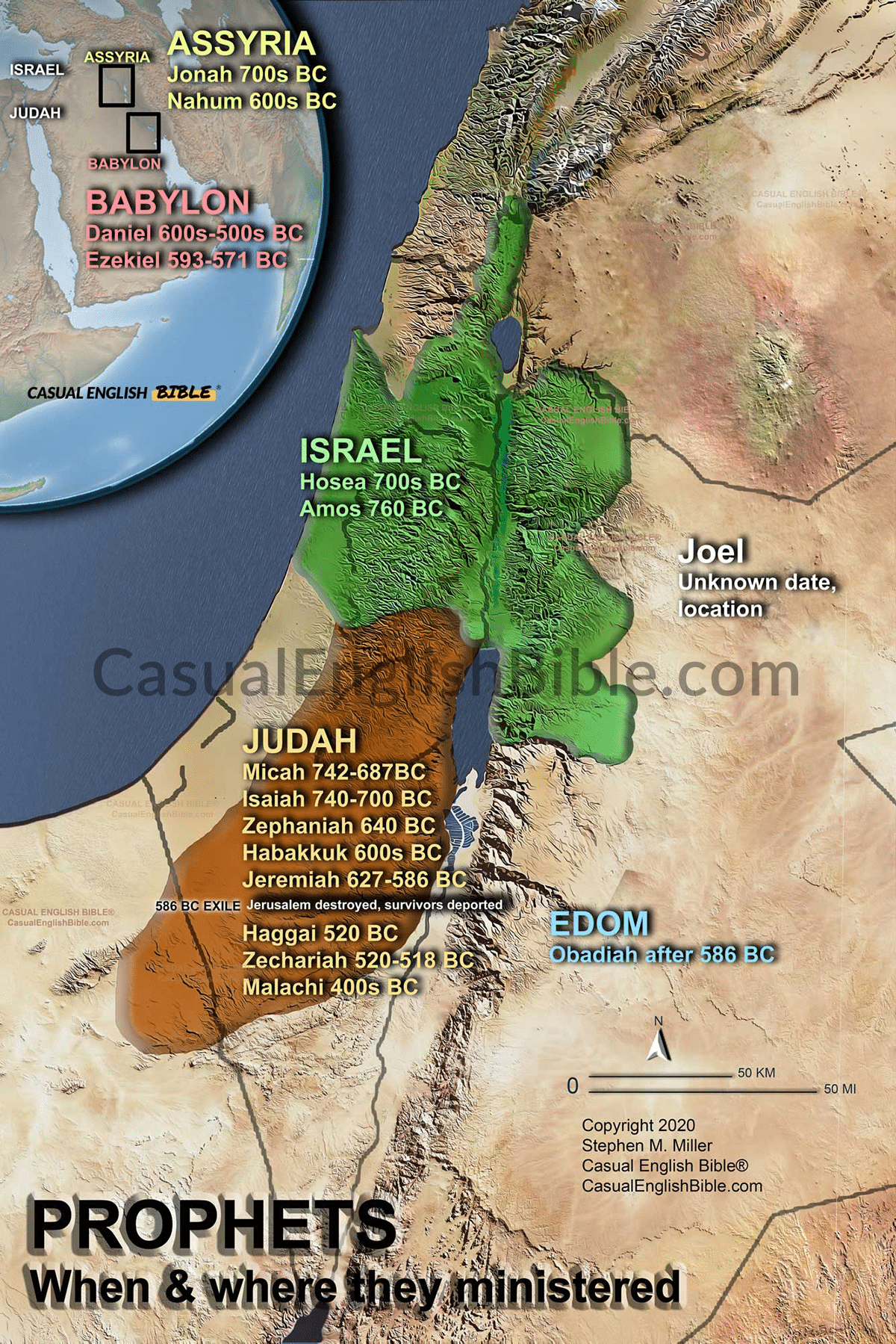
This Bible map collection helps readers follow Malachi’s world of Jerusalem, the Persian province of Judah, the rebuilt temple, Edom, surrounding nations, and a discouraged Jewish community learning that coming home from exile did not automatically change their hearts.
Description
Why Malachi Matters
Malachi is the prophet who tells the people of Judah, “Stop giving God your leftovers.”
The temple has been rebuilt.
The animal sacrifices have started again.
Priests are back at work.
The Jewish people are living in their homeland after generations of invasion, exile, and foreign rule.
Everything should be better.
It is not.
The people expected life to improve once they returned home and rebuilt the temple. Instead, they still live under the authority of the Persian Empire. Crops do not always cooperate. Money is tight. Jerusalem is no longer the capital of an independent kingdom.
The excitement of returning home has faded.
Now people are cutting corners.
Malachi probably preached sometime during the 400s BC, perhaps around the era of Ezra and Nehemiah. The Babylonian exile is over. Persia has conquered Babylon and allowed displaced people to return to their homelands.
Judah is back on the map, but barely.
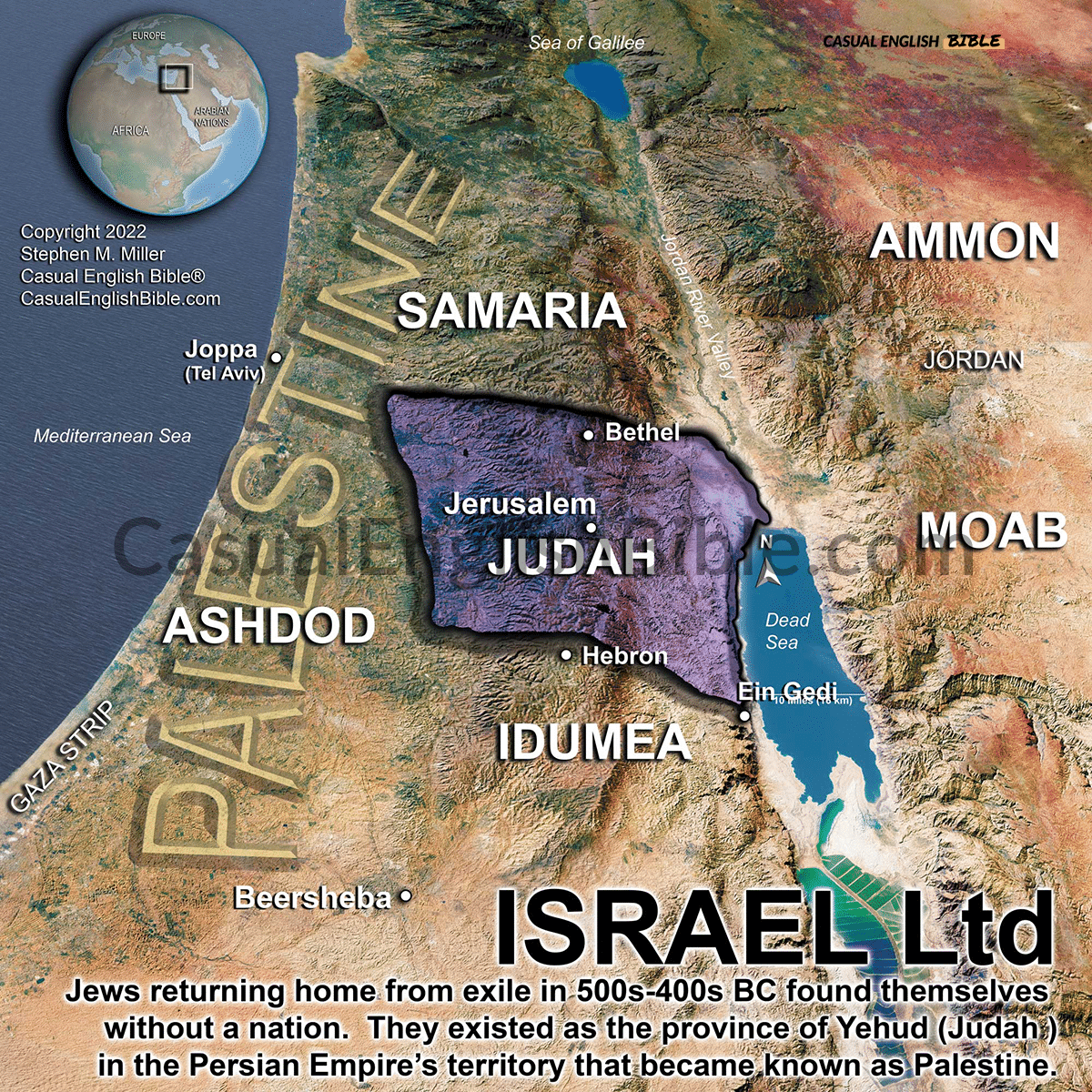
The old kingdom has become the small Persian province of Yehud, often translated Judah or Judea. A governor rules instead of a Jewish king. Jerusalem and the surrounding countryside make up only a fraction of the land the kingdoms of Israel and Judah once controlled.
The people have rebuilt the temple, but rebuilding a building is easier than rebuilding a nation.
Malachi sounds like a yeller because nearly everyone in the book seems determined to argue with God.
God says, “I love you.”
The people answer, “How have you loved us?”
God tells the priests, “You dishonor me.”
They answer, “How have we dishonored you?”
God says the people have robbed him.
They ask, “How have we robbed you?”
The book reads like a series of arguments between God and people who cannot understand why he is unhappy with them.
They are still religious.
They still bring sacrifices.
They still attend worship.
They simply do not think God deserves their best.
When worshipers choose an animal for sacrifice, they keep the healthy one and bring God the animal they do not want.
Blind animals.
Crippled animals.
Diseased animals.
Perhaps the animal would die soon anyway. Perhaps no one would buy it. The owner can get rid of it, fulfill a religious obligation, and keep the valuable livestock.
Everybody wins.
Except God.
Malachi quotes God saying:
“People, you bring me blind animals. That’s your sacrifice, your gift to me. Blind animals. And crippled critters. Diseased, as well….
Try giving animals like that to your governor. Would he be happy with you? Would he say, ‘Thank you very much for all these sick animals, I gratefully accept them’?” (Malachi 1:8).
The question is devastating.
They would never treat the Persian governor this way. They know he would consider the gift insulting.
But they assume God will take whatever they hand him.
The priests are part of the problem.
They know the rules. They know these animals are unacceptable. Yet they take them anyway and place them on the altar.
Perhaps they do not want to offend the worshipers. Perhaps they need the business. Perhaps they have stopped caring.
God says priests are supposed to teach people, preserve knowledge, and help them live faithfully.
Instead, these priests have made worship cheap.
Malachi warns them:
“Priests…if you don’t start showing me respect and honoring my name when you use it…I’m going to punish you in a way that will affect you and future generations of your family. The shame you’ll have to live with will be like walking around with manure on your faces” (Malachi 2:1–3).
Malachi is not a gentle touch.
He wants the priests to picture the waste removed from sacrificed animals being smeared across their faces. It is the prophet’s revolting way of saying their religious performance is not holy.
It is garbage.
The trouble does not stop at the temple.
Malachi says some Jewish men have abandoned the wives they married when they were young. They are breaking promises, betraying families, and then wondering why God does not seem impressed with their worship.
They cover the altar with tears because God is not accepting their offerings.
God’s answer is that they cannot mistreat people at home and then repair the damage with a religious ceremony.
Faithfulness to God includes faithfulness to people.
Malachi also condemns sorcery, adultery, lying, cheating workers out of their wages, and abusing widows, orphans, and immigrants.
These are not separate problems.
They all grow from the same attitude: people with power are using it to benefit themselves.
Then Malachi turns to money.
The people are withholding the tithes and offerings meant to support worship at the temple and provide food for those serving there.
God asks:
“So, you think it’s okay to rob God? …You’re robbing me of tithes and offerings” (Malachi 3:8).
Then God challenges them:
“Bring all the tithe to the Temple so we have food here at my house. Test me. Do it. Then watch what happens. I’ll open the windows of heaven and dump a barrel of blessing all over you” (Malachi 3:10).
This is not a get-rich-quick promise for anyone who sends money to a persuasive preacher.
Malachi is speaking to an ancient Jewish community living under its agreement with God. The people are withholding what that agreement requires, leaving the temple without the food and support needed for its work.
God tells them to stop cheating and see whether faithfulness changes anything.
Some people have become so discouraged that they openly question whether serving God is worthwhile.
They look at arrogant and dishonest people who seem to be doing well. The wicked prosper. The cheaters get ahead. The faithful struggle.
So they ask what many people still ask:
“What is the point of doing right?”
Malachi does not deny that unfair people sometimes prosper.
He says the present moment is not the end of the story.
A day is coming when the difference between good and evil will become clear. God will remember the people who remain faithful, even when faithfulness seems to bring them no advantage.
Malachi says the coming day will burn like a furnace for those who have built their lives on arrogance and cruelty.
But for people who honor God:
“The sun of righteousness will rise,
bringing healing like sunlight” (Malachi 4:2).
Malachi also promises that God will send a messenger to prepare the way for his arrival.
The Christian Gospels connect that promise to John the Baptist, who prepared people for the ministry of Jesus.
The book ends by saying the prophet Elijah will come before the great Day of the Lord. He will turn parents and children back toward one another.
That is a fitting end for Malachi.
The book begins with people questioning God’s love.
It ends with the possibility of reconciliation.
Priests can change.
Families can heal.
People can stop cheating.
A community that returned from exile can return to God as well.
Malachi matters because he refuses to let religious people confuse activity with devotion.
A person can attend worship and still insult God.
A priest can perform ceremonies and still have a rotten attitude.
A worshiper can put something on the altar without making a meaningful sacrifice.
A nation can rebuild its temple without repairing its character.
Malachi says God does not need people’s leftovers.
He wants their loyalty, their honesty, their justice, and their hearts.
Maps for Teaching Malachi
This Bible map collection gives readers geographic and historical context for Malachi, including Jerusalem, the Persian province of Yehud or Judah, Babylon, Persia, Edom, and the surrounding regions that shaped Jewish life after the exile.
The maps help teachers and students visualize Malachi’s world: a small Jewish province under Persian rule, a rebuilt temple operating in Jerusalem, an independent kingdom replaced by a foreign-appointed governor, and a discouraged community living among the remains of what Judah had once been.
The maps also provide context for Malachi’s opening message about Jacob and Esau, the neighboring land of Edom, the return from Babylonian exile, and the Jewish homeland during the 500s and 400s BC.
This collection is designed for pastors, Bible teachers, small groups, Sunday school classes, homeschool families, and readers who want help teaching Malachi with clear maps, historical context, and plain-English visual support.
Malachi Bible Map Collection
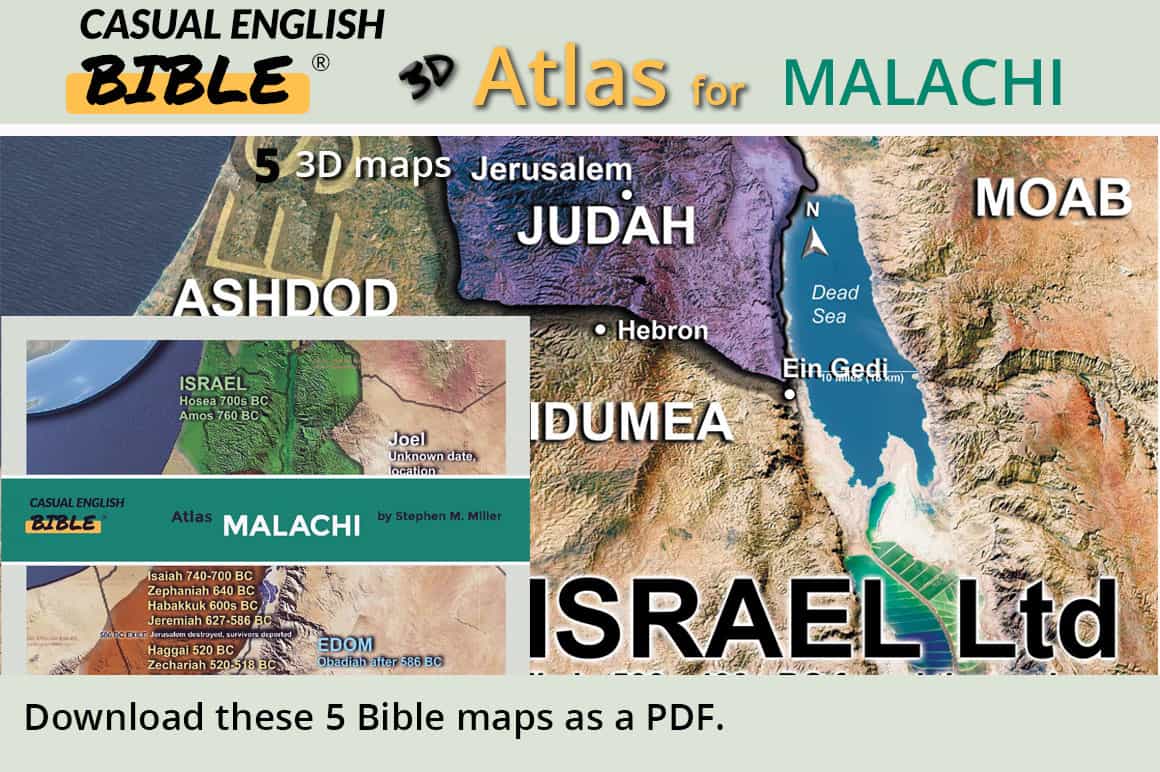
- Maps: 5 high-resolution Bible maps in 3D style
- Instant PDF download
- Optional licensing available for broader use
The product includes two files for immediate download:
📱 Maps optimized for use in mobile devices; file size 3 MB
🖥️ Maps in higher resolution, 12 MB
Click to view all maps in the Malachi Bible Map Collection
Malachi Bible Atlas
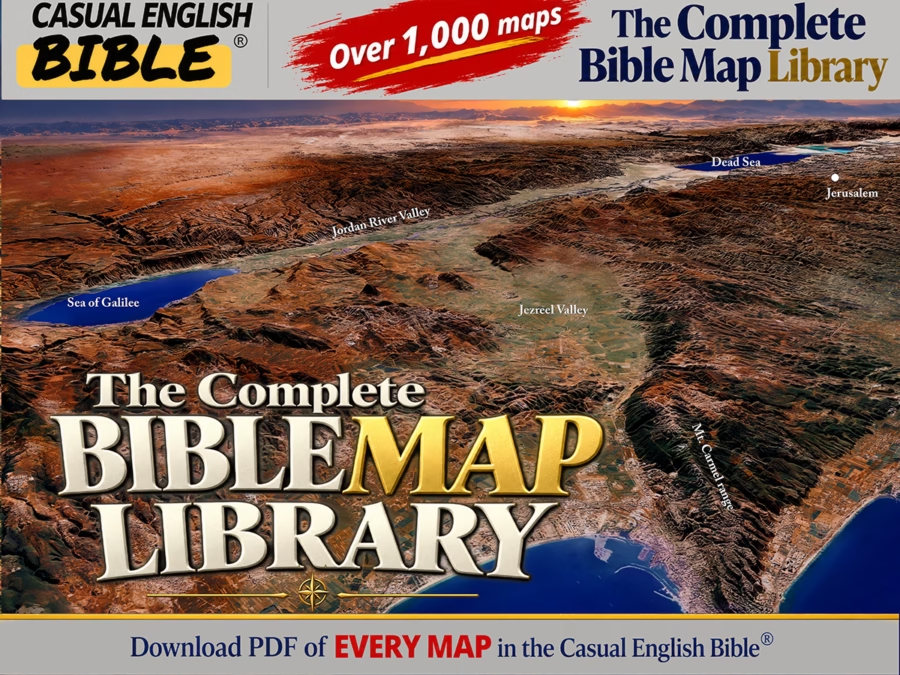
The Complete Bible Map Library
- 1,000+ Bible maps
Many in immersive 3D-style terrain so you can visualize the land, not just read about it - 1,298 pages
A massive, chapter-by-chapter visual companion to the Bible - Two versions included
- 📱 Mobile-optimized (157 MB) — fast, smooth, and easy to use on phones & tablets
- 🖥️ Full-resolution (1.2 GB) — maximum detail for deep study and large screens
- Covers the entire Bible
Every book with meaningful geography—from Genesis to Revelation
SALE Original price was: $80.00.$75.00Current price is: $75.00.