
The Complete Bible Map Library
SALE Original price was: $80.00.$75.00Current price is: $75.00.

Nahum - Bible Map Collection
Original price was: $19.00.$10.00Current price is: $10.00.
Nahum Tells Nineveh, “Your Time Is Up”
Nineveh, capital of the Assyrian Empire, rules through terror. Assyria has destroyed cities, deported nations, and scattered the people of Israel. Its kings seem unstoppable.
Nahum the prophet says they are not.
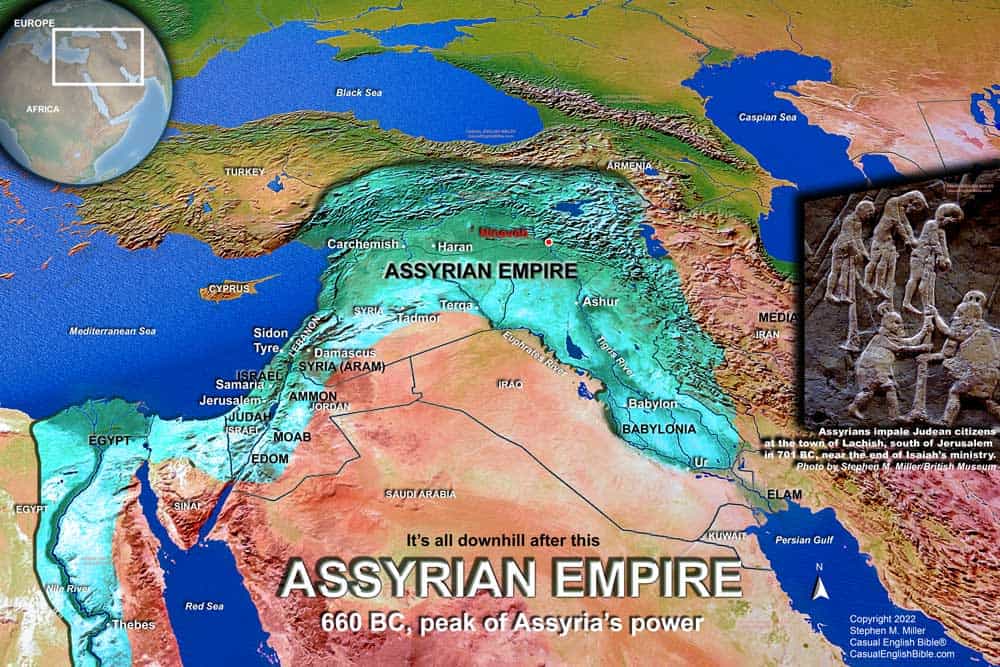
This Bible map collection helps readers follow Nahum’s world of Nineveh, Assyria, Judah, Israel, Babylon, Media, the Tigris River, and the cities and nations caught beneath the weight of the most feared empire in the ancient Middle East.
Description
Why Nahum Matters
Nahum is the prophet who tells the most frightening empire in the world, “Your time is up.”
He directs his message toward Nineveh, capital of the Assyrian Empire. Assyria had spent generations invading countries, destroying cities, carrying survivors into exile, and bragging about the suffering it caused.
The Assyrians did not hide their cruelty. Their kings carved pictures of defeated enemies onto palace walls. They recorded how they burned cities, mutilated prisoners, and displayed bodies as warnings to anyone thinking about rebellion.
Fear was part of their foreign policy.
By Nahum’s time, Assyria had already destroyed the northern kingdom of Israel and deported many of its people. It had invaded Judah, captured fortified cities, and nearly taken Jerusalem.
To a small kingdom like Judah, Assyria must have looked permanent.
Nahum says it is not.
He describes Nineveh as a city full of lies, robbery, violence, and bloodshed:
“Sin city, where crime calls home—the city where sin never sleeps” (Nahum 3:1).
Nahum does not ask Nineveh to improve its behavior. He does not offer the city another warning period. He announces its funeral.
That makes Nahum feel very different from Jonah.
More than a century earlier, Jonah had walked through Nineveh warning that the city would be destroyed in 40 days. The people repented, from the king down to the common citizens. They even dressed their animals in mourning clothes.
God spared the city.
Nahum comes later, after Assyria has returned to violence and built an empire on it. This time the message is not, “Repent and perhaps you will survive.”
The message is, “It is over.”
Nahum pictures armies charging through the streets. Shields flash red. Chariots race wildly. Gates collapse. The city floods with enemy soldiers. People stumble away carrying whatever they can save.
The prophet almost seems to stand inside Nineveh while it falls.
He taunts the city that once terrified everyone else. Where are your leaders now? Where are your soldiers? Where are the allies who promised to help? Where is all the treasure you stole from other nations?
Gone.
Nahum compares Nineveh to a lion’s den. Assyria’s kings behaved like lions, killing prey and dragging the remains home to feed their families. The empire filled its palaces with wealth taken from conquered people.
God says he is coming after the lions.
That is the main idea of Nahum: powerful nations are still accountable for what they do.
Assyria may be stronger than Judah. Its army may be larger. Its walls may seem impossible to breach. None of that makes the empire untouchable.
In 612 BC, Babylonian and Median forces attacked Nineveh. The city fell after a brutal siege. The conquerors looted it, burned it, and left much of it in ruins.
The Assyrian Empire struggled on for a few more years, but its power was broken.
Nahum had said the empire’s leaders would disappear and its people would scatter:
“Shepherds who led your nation are sleeping.
Great King of Assyria, they’ll never wake up.
What’s left of your people now hide in the hills.
There are no shepherds left to lead them” (Nahum 3:18).
Ancient Babylonian writers also recorded Nineveh’s destruction. They pressed the story into clay tablets using wedge-shaped cuneiform characters. Their account describes the invading armies surrounding the city, capturing it, carrying away its wealth, and turning it into ruins.
Nineveh eventually became so thoroughly abandoned that later generations argued about where the famous city had stood.
Nahum ends without feeling sorry for it.
That can make the book uncomfortable. The prophet celebrates the destruction of a city. But he writes from the viewpoint of people who have watched Assyria murder, enslave, deport, and terrorize nation after nation.
To them, Nineveh’s fall did not look like random destruction. It looked like liberation.
Nahum matters because he speaks to people who wonder whether cruelty always wins.
His answer is no.
An empire may dominate the world for generations. Its leaders may believe no one can stop them. Its victims may feel forgotten. But power does not erase guilt, and success does not turn evil into good.
Nineveh looked permanent right up until it fell.
Maps for Teaching Nahum
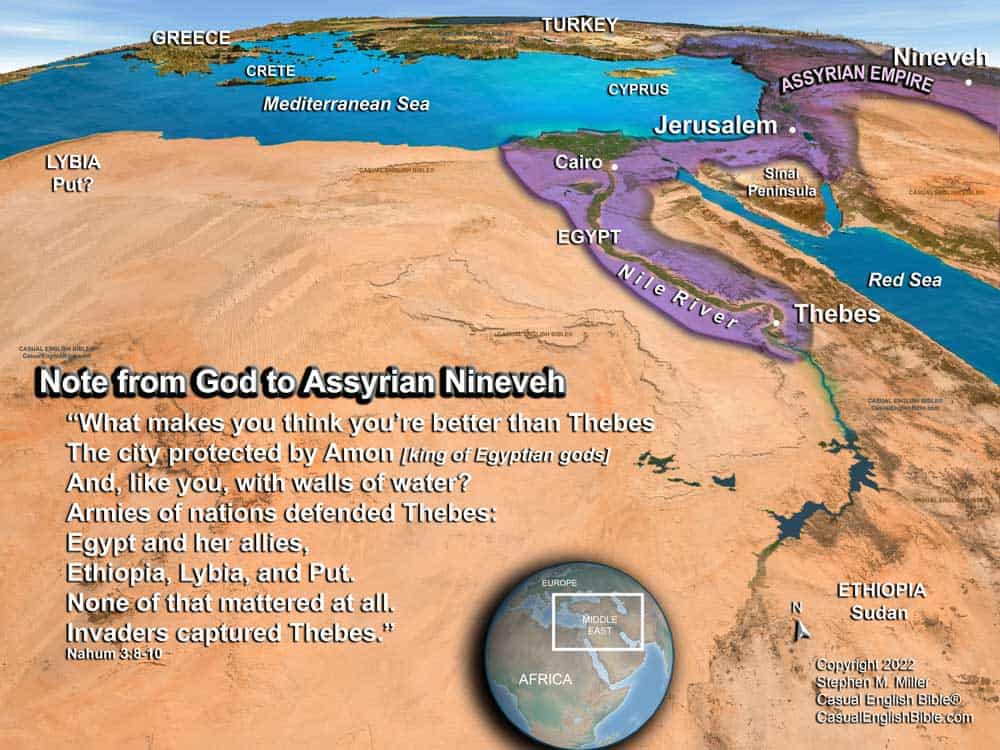
This Bible map collection gives readers geographic and historical context for Nahum, including Nineveh, the Assyrian Empire, Judah, Israel, Babylon, Media, the Tigris River, Assyrian invasion routes, and the nations that joined together to bring Nineveh down.
The maps help teachers and students visualize Nahum’s world: a small kingdom living in the shadow of a violent empire, a capital city protected by massive walls, and enemy armies gathering from the east and south to destroy a city that seemed impossible to defeat.
This collection is designed for pastors, Bible teachers, small groups, Sunday school classes, homeschool families, and readers who want help teaching Nahum with clear maps, historical context, and plain-English visual support.
Nahum Bible Map Collection
Maps: 9 high-resolution Bible maps in 3D style
Instant PDF download
Optional licensing available for broader use
The product includes two files for immediate download:
📱 Maps optimized for use in mobile devices; file size 2 MB
🖥️ Maps in higher resolution, 19 MB
Click to view all maps in the Nahum Bible Map Collection
Nahum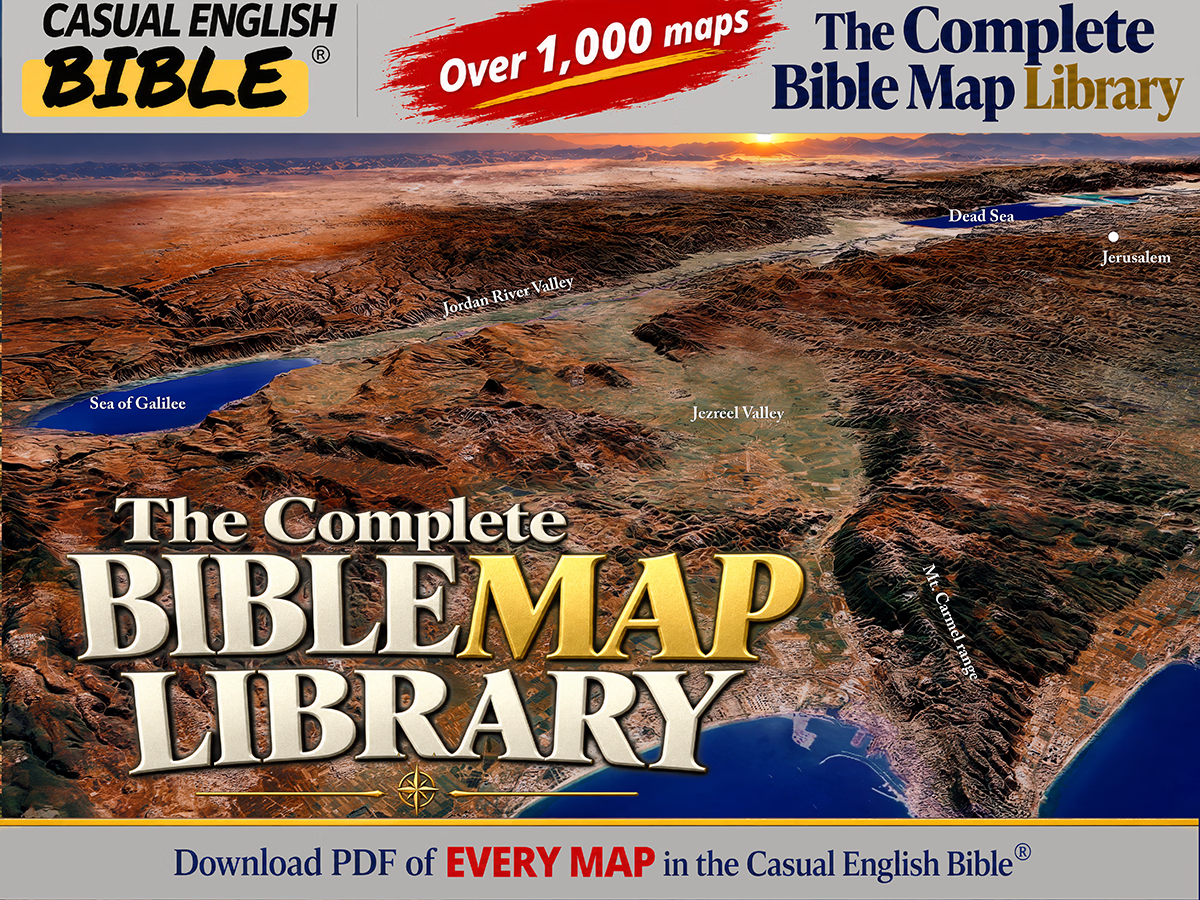
The Complete Bible Map Library
- 1,000+ Bible maps
Many in immersive 3D-style terrain so you can visualize the land, not just read about it - 1,298 pages
A massive, chapter-by-chapter visual companion to the Bible - Two versions included
- 📱 Mobile-optimized (157 MB) — fast, smooth, and easy to use on phones & tablets
- 🖥️ Full-resolution (1.2 GB) — maximum detail for deep study and large screens
- Covers the entire Bible
Every book with meaningful geography—from Genesis to Revelation
SALE Original price was: $80.00.$75.00Current price is: $75.00.


