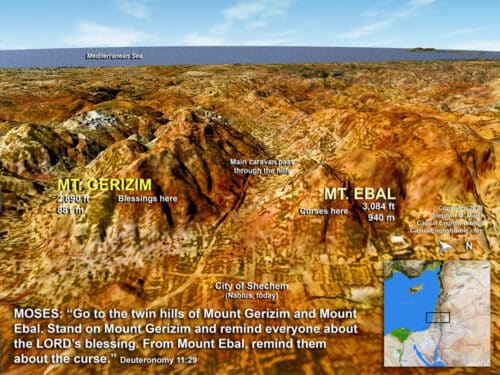
It’s unclear what Moses saw. The writer says Moses saw the northern boundary of the tribal territory, which is about 100 miles (160 km) from Mount Nebo. And he saw the Negev desert and Zoar, a city that scholars typically say was located around the southern part of the Dead Sea. Genesis says that’s where Lot and his daughters went when they escaped the fiery destruction of the twin cities of Sodom and Gomorrah (Genesis 19:23). Zoar and the Negev were over 70 miles (113 km) south of Moses. Mount Nebo has the highest summit on the plateau, at 2,300 feet elevation, or 710 meters. That’s an especially good vantage point to view what is now Jordan River Valley areas of Israel and Palestinian territories. That’s because the Dead Sea is about 1,400 feet below sea level, or 430 meters. That puts Moses more than a kilometer above the Jordan River Valley, about three-fourths of a mile. But it might seem a stretch to think of Moses literally seeing 100 miles from a mountain just half a mile high. Some scholars say Moses saw the land in general—not in crisp detail—as far as the angle on the horizon permitted. Some others say Moses may have seen more. Perhaps he saw the land in a vision or in some other way. The apostle Paul talked about a man (possibly himself) who was “somehow transported all the way up to the third heaven. I don’t know if this was an out-of-body experience. Only God knows” (2 Corinthians 12:2).