Sabbath sacrifices
1This is what the Lord God says:Close the eastern gateway to the inner courtyard around the altar and Temple building all six working days of the week, Sunday through Friday. Open it to the public only on the Sabbath [1] day or on the day of the New Moon, at the beginning of each new month.
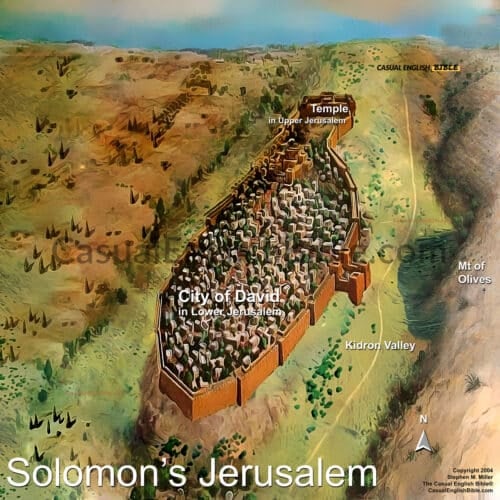
2When the ruler comes to worship at the Temple, he’ll enter through the gateway and stop at the end of the hall, in the vestibule, an entryway room. He should stand there by the doorpost while priests sacrifice his burnt offering [2] and take his peace offering. [3] Then he should bow at the threshold of the gateway and leave. But the gate should stay open for others until the evening. 3People should come to the Temple to worship the Lord when the gateway is open each Sabbath and at the beginning of each month.
4This is the burnt offering that the ruler should bring to the Lord every Sabbath day: six male lambs and an adult male sheep, which is a ram. These animals should be perfectly healthy and have nothing else wrong with them.
5Here’s the peace offering he should give in addition to the burnt offering of sheep: at least half a bushel [4] of grain, though he can give as much grain as he likes. He should also give a gallon [5] of olive oil for each half bushel of grain he offers.
New Moon sacrifices
6For the new moon sacrifice he should offer a young bull, in addition to the six lambs and adult male sheep. No animal should have anything wrong with it.7The ruler should give half a bushel of grain with the bull and half a bushel of grain with the ram. But with the lambs he can give as much grain as he can afford. 8When the ruler comes into the Temple, he should come through the gateway vestibule. And he should leave the way he comes in.
9When other people come into the Temple to worship during special holidays they should exit through the opposite gateway. If they come into the Temple courtyard from the north gate, for example, they need to leave through the south gate. And if they come in through the south gate, they need to leave through the north gate. They should simply exit from the opposite gate they came in. [6] 10On those holidays, the ruler should join the people and go in the way they go in and leave the way they leave.
11At each of these holidays and special feasts and established times of worship, the ruler needs to bring half a bushel of grain with a young bull and half a bushel of grain with a ram. When the ruler brings lambs, he can bring as much grain as he would like. But for each half-bushel of grain he brings, he should add a gallon of olive oil. 12The ruler should also bring a special gift to the LORD. He should bring a burnt offering or a fellowship offering. When he brings either offering, he should come through the eastern gate. And he should do this on the Sabbath day. After he does this, the gate should be closed.
13Every day you should sacrifice a year-old lamb that is perfectly healthy and has nothing wrong with it. Do that every morning. 14Also bring a grain offering of about three quarts of flour and about a quart of olive oil. This law is permanent. 15So, every morning I want you to make this offering, an offering of the lamb, the grain, and the olive oil. Every morning. No exceptions.
Inheritance gifts: no takebacks from prince
16This is what the Lord God says:If the ruler gives some land to one of his sons as an inheritance, he can't take it back or give it away to someone else. It belongs to his son and the descendants of his son. [7] 17But if the ruler gives land to one of his servants, [8] the servant can keep the land only until the Year of Jubilee, [9] which comes every 50 years. In the Year of Jubilee, the servant has to return the land to the ruler. This rule does not apply if the ruler gives land to any of his sons. Those gifts to his sons are for good. The king can't take those back.
18The ruler is not allowed to take anyone's land against the landowner's will. [10] If a ruler gives land to any of his sons, this has to be the ruler's land. He cannot take someone else's land and give it to his sons.
Four Temple kitchens
19In my vision I was led to the north-facing sacred rooms of priests. The guide told me, this is where priests cook their holy meals from offerings of meat and grain that people bring to the Temple. 20Here is where they boil the meat and bake the flour. They do it here so people don't accidentally come into contact with the food, which is holy and meant only for the priests. [11]21Next, he took me to the outer courtyard, and we walked along the walls to each of the four corners. Every corner had an enclosure, a fenced off area. 22Every enclosure was exactly the same size, roughly 70 feet long and 50 feet wide. [12] Each one was fenced off from the rest of the courtyard. 23Each room had a stone ledge along the walls, above a fireplace. Every room had these.
24The guide told me that these are the kitchens where the Levite Temple assistants boil the sacrificial meat that people bring to the Temple. [13]