


Isaiah – Bible Map Collection
Original price was: $49.00.$25.00Current price is: $25.00.
Judah in the Bullseye Bible Map: Four Nations Attack Judah in 735 BC
$10.00
Judah in the Bullseye: When Four Nations Threatened a Kingdom
What happens when a small kingdom finds itself surrounded by powerful enemies? Around 735 BC, Judah faced growing threats from neighboring nations as the kingdoms of Israel and Syria joined forces against Jerusalem. Meanwhile, the Philistines attacked from the west, and Edom threatened Judah from the south. This map brings the conflict to life, showing the surrounding territories and the routes that made Judah vulnerable during one of the most dangerous periods in its history.
Description
How Judah Became the Target of Regional Conflict
During the eighth century BC, the kingdoms of Israel and Judah faced increasing pressure from the expanding Assyrian Empire. As Assyria grew stronger, smaller kingdoms in the region struggled to protect their independence. Israel, also known as the northern kingdom, and Syria (Aram) formed an alliance and tried to pressure Judah into joining their resistance against Assyria.
This conflict became known as the Syro-Ephraimite crisis. King Ahaz of Judah faced attacks from Israel and Syria, whose rulers wanted to replace him with a king who would support their plans. The prophet Isaiah delivered a message to Ahaz during this crisis, urging him to trust God rather than place his confidence in political alliances (Isaiah 7).
The map highlights Judah’s vulnerable position among neighboring territories. Israel and Syria appear to the north, the Philistines occupy areas along the Mediterranean coast, and Edom lies to the south. These locations help explain how Judah could face pressure from multiple directions. The map also identifies important places such as Jerusalem, Samaria, Damascus, and the surrounding valleys and river routes.
The biblical account describes attacks against Judah by Israel and Syria, followed by Philistine and Edomite incursions during Ahaz’s reign. According to 2 Chronicles 28, the Philistines captured several towns, while the Edomites invaded Judah and took captives. Ahaz eventually appealed to Assyria for help, but that decision brought its own political and spiritual consequences.
The year 735 BC is associated with the period leading into this crisis, although the attacks and major events unfolded over several years. By studying the geography, readers can see why Judah’s position mattered and how the rival kingdoms shaped its choices. The story also provides the setting for Isaiah’s message about fear, faith, and the consequences of trusting human power instead of God.
What You Get
- A geographical overview of Judah and its neighboring kingdoms around 735 BC.
- The locations of Israel, Syria (Aram), Edom, and the Philistines.
- Key biblical cities, including Jerusalem, Samaria, Damascus, and Beersheba.
- A visual explanation of Judah’s vulnerable position among competing kingdoms.
- Historical context for the Syro-Ephraimite crisis and the reign of King Ahaz.
- Connections to the prophetic messages of Isaiah during a time of political uncertainty.
- A Bible study resource for exploring the relationship between geography, warfare, faith, and political alliances in the Old Testament.
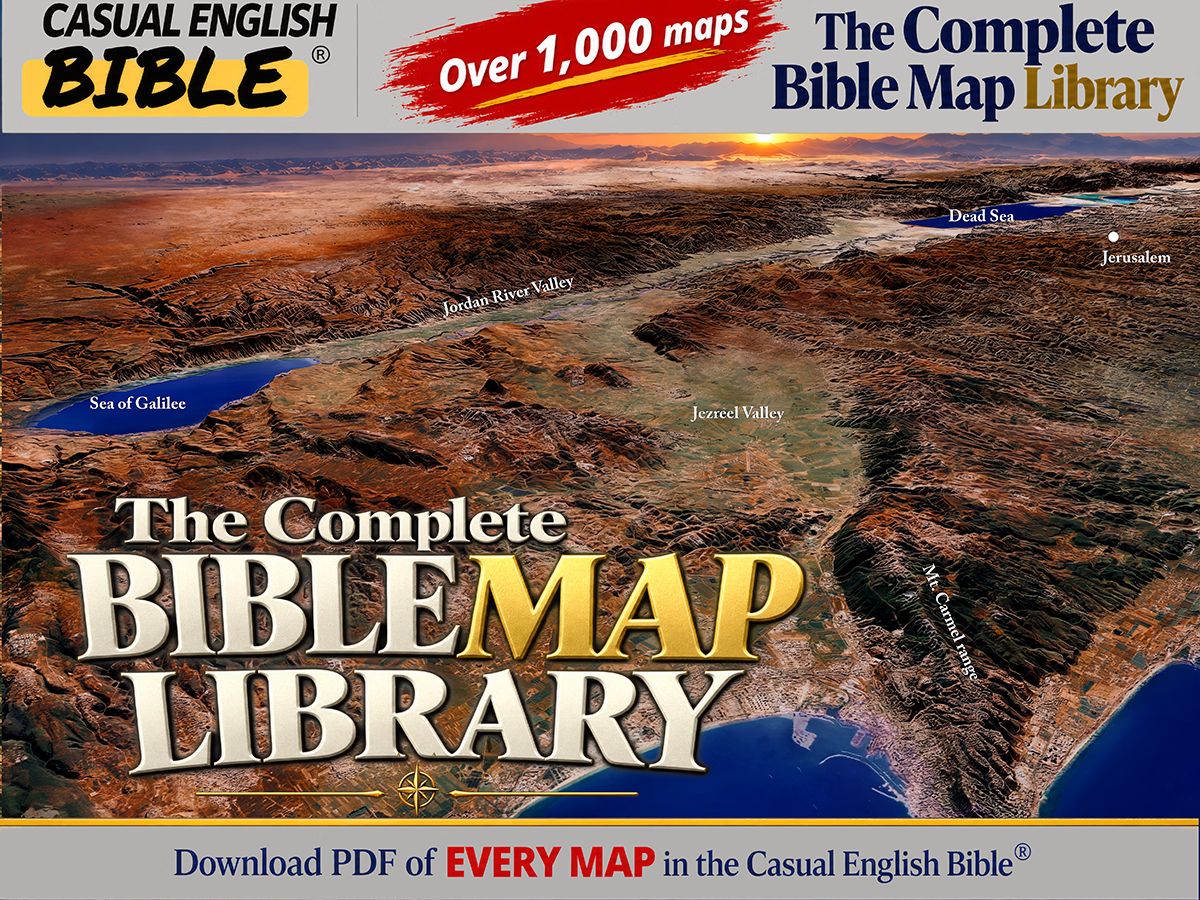
The Complete Bible Map Library
More than 1,000 Bible maps: Get a feel for the lay of the land
What if you could follow the entire Bible on a map—chapter by chapter?
This is every map we’ve created for the Casual English Bible®, all in one place. If geography shows up in a chapter, there’s a map for it. And as new maps are added, they’re included—no extra cost.
You’re not just reading the story anymore. You’re seeing where it happened.
SALE Original price was: $80.00.$75.00Current price is: $75.00.


Reviews
There are no reviews yet.