
The Levites received no large tribal territory—but they lived throughout the entire nation.
Instead of inheriting one region like the other tribes, the Levites were given cities scattered across Israel. This arrangement allowed them to serve the people, teach God’s law, and oversee worship in every part of the land.
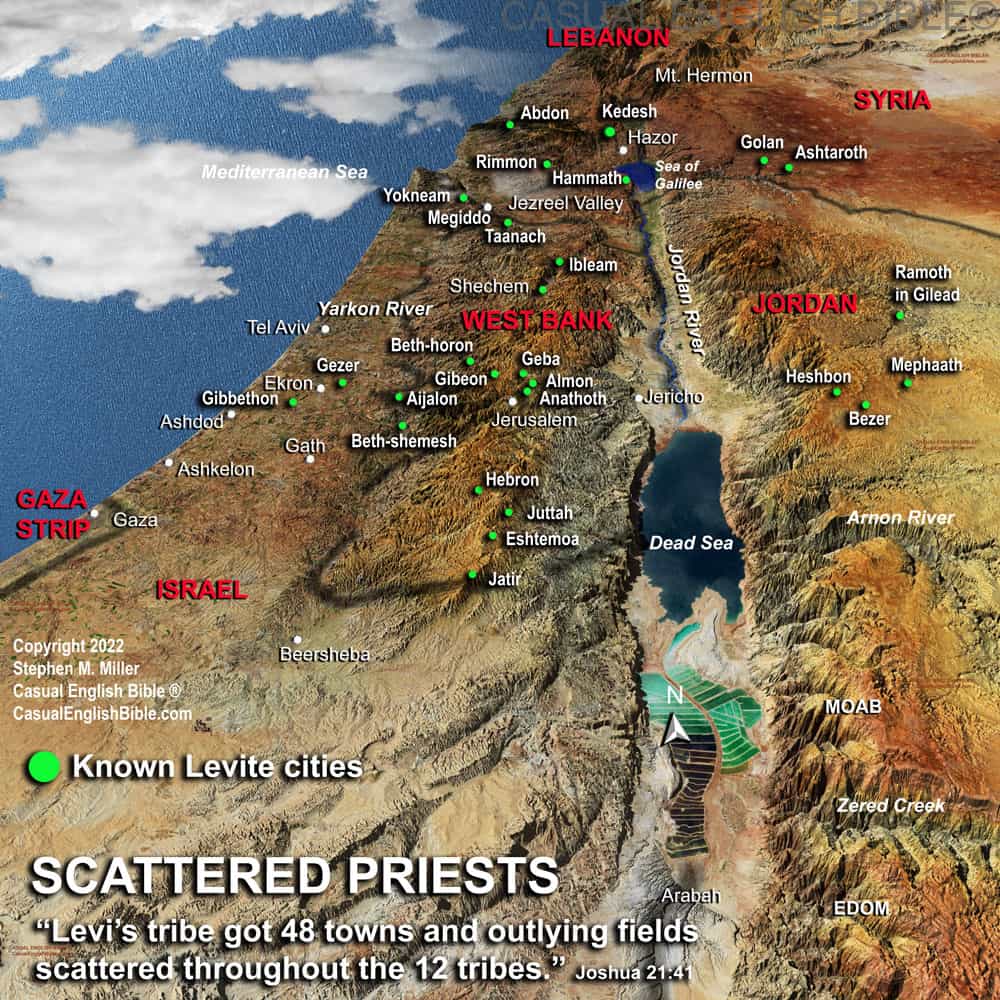
This map shows where the Levitical cities were located and explains how they fit into Israel’s tribal inheritance.
The Cities Given to the Tribe of Levi
After the conquest of Canaan, the land was divided among the tribes of Israel. Unlike the other tribes, however, the Levites did not receive a large, continuous territory of their own. Their special role was to assist with worship, care for the Tabernacle, and teach God’s law, so they were given cities distributed throughout the nation.
Joshua 21 lists forty-eight Levitical cities, including six Cities of Refuge. Living among all the tribes allowed the Levites to serve the entire nation instead of remaining in a single region. Their presence helped maintain Israel’s spiritual life and ensured that priestly ministry was available across the land.
The geography reveals the wisdom of this arrangement. The Levitical cities were spread from the northern hills to the southern wilderness and on both sides of the Jordan River. This made it possible for people throughout Israel to have access to religious instruction and priestly leadership without traveling great distances.
Understanding the distribution of the Levitical cities helps readers appreciate how worship and teaching were woven into everyday life in ancient Israel. This map provides a clear picture of where the Levites lived and how they served the nation after the land was divided among the tribes.
