Ezekiel – Bible Map Collection
Original price was: $40.00.$30.00Current price is: $30.00.
Babylonian Invasion of Judah Bible Map: Jerusalem’s Siege and the Fall of King Zedekiah
$10.00
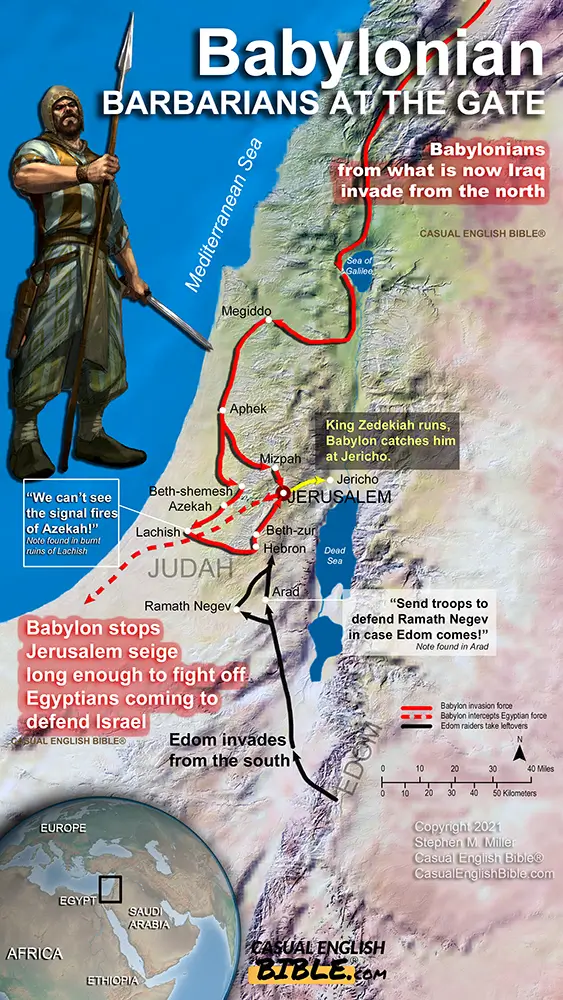
Babylonian Barbarians at the Gate: Judah Under Attack
How did the powerful Babylonian Empire bring the kingdom of Judah to its knees? As Babylonian armies advanced from the north, Jerusalem faced a devastating siege, while Egypt and Edom became involved in the unfolding conflict. This map traces the invasion routes, key battles, and surrounding nations that shaped Judah’s final years as an independent kingdom. Follow the events that led to Jerusalem’s fall and King Zedekiah’s capture, revealing how political alliances and military pressure changed the course of biblical history.
Description
Babylon’s Campaign Against Judah and the Fall of Jerusalem
During the late seventh and early sixth centuries BC, the Babylonian Empire rose to power in the ancient Near East. After defeating Assyria, Babylon turned its attention toward the lands west of the Euphrates River, including Judah. The small kingdom sat between competing powers and struggled to survive as Babylon expanded its influence.
The map highlights Babylon’s invasion routes through the region, showing places such as Megiddo, Aphek, Mizpah, Lachish, Jerusalem, Jericho, and Hebron. These locations help explain the strategic importance of Judah’s hill country, its fortified towns, and the routes connecting the Mediterranean coast with the Jordan River Valley.
Jerusalem became the central target of Babylon’s military campaigns. King Zedekiah eventually rebelled against Babylonian authority, hoping to regain Judah’s independence. According to 2 Kings 25 and Jeremiah 39, Babylonian forces surrounded Jerusalem, breached its defenses, and captured the king as he attempted to escape. Zedekiah was taken to Babylon, and Jerusalem and its temple were destroyed in 586 BC.
The map also illustrates the involvement of neighboring nations. Egypt attempted to intervene against Babylon, temporarily affecting the siege of Jerusalem. Edom posed another threat from the south, while Babylonian forces continued to pressure Judah’s remaining towns. These events show how Judah was caught between larger regional powers and how its political decisions had serious consequences.
The biblical prophets repeatedly warned that Judah’s unfaithfulness and injustice would bring judgment. Jeremiah urged the people to recognize Babylon’s dominance rather than rely on military alliances to save them. The fall of Jerusalem became a turning point in Israel’s history, leading to the exile of many people and the end of the kingdom of Judah as an independent monarchy.
Studying the geography helps bring these events into focus. The distances between Jerusalem, the fortified towns of Judah, the coastal approaches, and the southern wilderness reveal the challenges of defending the kingdom. The map connects the biblical accounts of invasion and exile with the real landscape where these dramatic events unfolded.
The Complete Bible Map Library
More than 1,000 Bible maps: Get a feel for the lay of the land
What if you could follow the entire Bible on a map—chapter by chapter?
This is every map we’ve created for the Casual English Bible®, all in one place. If geography shows up in a chapter, there’s a map for it. And as new maps are added, they’re included—no extra cost.
You’re not just reading the story anymore. You’re seeing where it happened.
SALE Original price was: $80.00.$75.00Current price is: $75.00.