
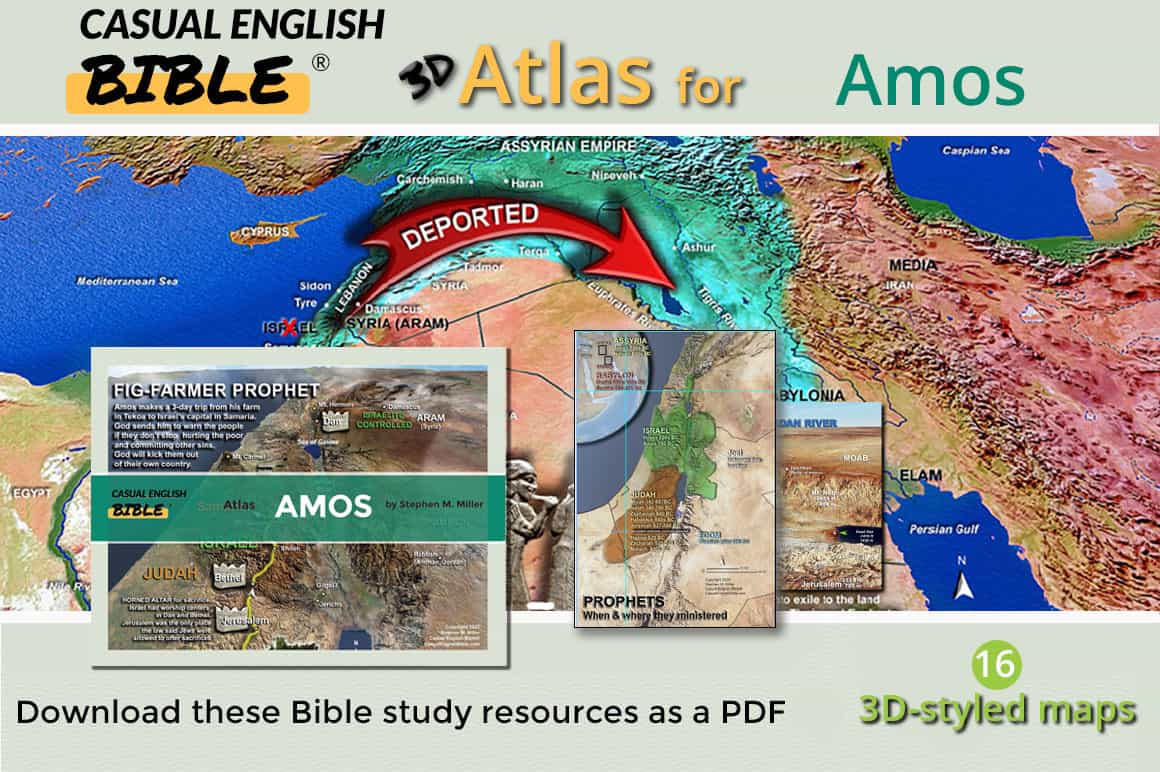



Amos - Bible Map Collection
Original price was: $29.00.$16.00Current price is: $16.00.
Amos Blasts the Rich for Crushing the Poor
Amos was not a palace prophet with soft hands and careful manners. He was a shepherd and fig farmer from Judah who marched north and told Israel’s rich, religious, comfortable people that God had heard the poor crying.
This Bible map collection helps readers follow Amos’s world of Judah, Israel, Samaria, Bethel, Tekoa, Damascus, Gaza, Tyre, Edom, Moab, Ammon, and the nations Amos names before turning his fire on Israel itself.
Description
Why Amos Matters
Amos is the prophet who sounds like he has dirt under his fingernails and fire in his throat.
He was not a professional prophet trained for polite religious speeches. He was a shepherd and a fig farmer from Tekoa, a village in Judah, south of Jerusalem. Then God sent him north to preach in Israel, the richer and more powerful Israelite kingdom with Samaria as its capital.
That was not a friendly assignment.
Amos walked into a nation that looked successful from the outside. Israel had wealth, strong cities, active worship centers, religious festivals, music, sacrifices, and people who knew how to enjoy themselves. The rich had houses, parties, wine, beds inlaid with ivory, and enough confidence to think the good times would keep rolling.
Amos said the whole thing stank.
His complaint was not that Israel had too much fun. His complaint was that the good life was being built on the backs of poor people. Courts were corrupt. Merchants cheated customers. Powerful people crushed the weak. Religious people kept bringing offerings while ignoring the people God told them to protect.
Amos does not tiptoe into the room. He starts by announcing judgment on surrounding nations: Damascus, Gaza, Tyre, Edom, Ammon, Moab, and Judah. Israel’s listeners may have nodded along at first. Everybody enjoys hearing a prophet roast the neighbors.
Then Amos turns the fire on Israel.
He attacks the wealthy women of Samaria with one of the most shocking insults in the prophets, calling them pampered cows grazing on the hills while poor people suffer. He says Israel has turned justice poisonous. He says their worship songs are noise to God. He says God does not want their religious performances while they are trampling people who can barely survive.
That is why Amos is still quoted by people who care about justice. His words are not vague religious poetry. They are a blast against systems that let the rich get richer while the poor get crushed.
One of the most famous lines in Amos says, “Let justice roll down like water, and righteousness like a never-ending stream.” In plain English, Amos is saying: stop pretending worship matters if justice is dry as dust.
The religious leaders did not appreciate the sermon.
At Bethel, one of Israel’s major worship centers, a priest named Amaziah tells Amos to go home. Take your visions back to Judah, he says. Do not preach here. This is the king’s sanctuary. This is a national temple.
Amos answers like a man who did not come looking for a career promotion. He says he was not a professional prophet. He was taking care of animals and fig trees when God grabbed him and sent him north.
Then he gives Amaziah a brutal warning about what will happen to his family and his nation when judgment comes.
Amos is not easy reading, but he is necessary reading. He shows that God is not impressed by religion that ignores injustice. He shows that worship can become disgusting when people sing loudly and cheat quietly. He shows that a nation can look strong, wealthy, and religious while already cracking inside.
And he shows why maps matter. Amos’s message moves across nations, borders, capitals, temples, trade routes, and enemy territories. The geography helps readers see the world Amos was judging: a small divided Israelite people surrounded by powerful neighbors, with Assyria waiting in the distance like a storm not yet fully visible.
Maps for Teaching Amos
This Bible map collection gives readers geographic and historical context for Amos, including Judah, Israel, Tekoa, Samaria, Bethel, Damascus, Gaza, Tyre, Edom, Moab, Ammon, and the surrounding nations named in Amos’s opening judgment speeches.
The maps help teachers and students visualize Amos’s world: a farmer-prophet from Judah sent north to Israel, a wealthy kingdom near collapse, worship centers like Bethel, corrupt power in Samaria, and nations around Israel facing judgment for violence and cruelty.
This collection is designed for pastors, Bible teachers, small groups, Sunday school classes, homeschool families, and readers who want help teaching Amos with clear maps, historical context, and plain-English visual support.
Amos Bible Map Collection
- Maps: 4 high-resolution Bible maps in 3D style
- Instant PDF download
- Optional licensing available for broader use
The product includes two files for immediate download:
📱 Maps optimized for use in mobile devices; file size 17 MB
🖥️ Maps in higher resolution, 24 MB
Click to view all maps in the Amos Bible Map Collection
Amos Bible Atlas
The Complete Bible Map Library
- 1,000+ Bible maps
Many in immersive 3D-style terrain so you can visualize the land, not just read about it - 1,298 pages
A massive, chapter-by-chapter visual companion to the Bible - Two versions included
- 📱 Mobile-optimized (157 MB) — fast, smooth, and easy to use on phones & tablets
- 🖥️ Full-resolution (1.2 GB) — maximum detail for deep study and large screens
- Covers the entire Bible
Every book with meaningful geography—from Genesis to Revelation
SALE Original price was: $80.00.$75.00Current price is: $75.00.


