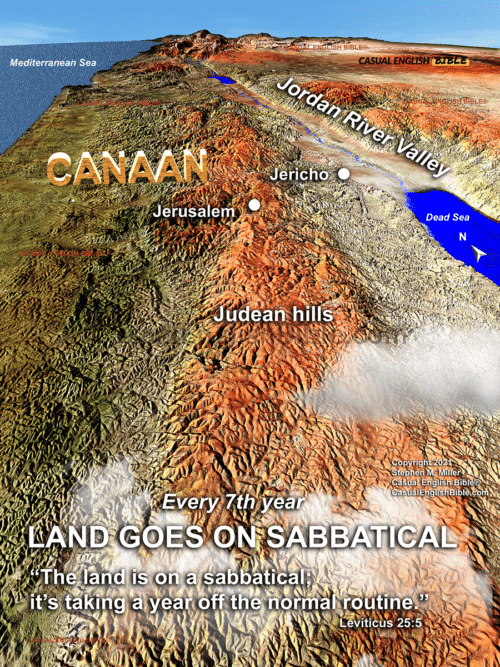
Land takes sabbatical
1The Lord met with Moses on Mount Sinai and told him:2Give this message to the people of Israel:
When you reach the land I'm giving you, I want you to remember something. The land itself needs time to rest—a Sabbath year honoring the LORD.
3For six years you can plant your fields and prune your vineyards. And you’re free to harvest everything you grow. 4But in the seventh year, give the land a Sabbath kind of rest, in honor of the LORD. Don't plant anything and don't prune your vineyard. Just let everything grow on its own.
5When it seems time to harvest the plants that grew on their own, don’t do it. I don’t want you to treat this like any other harvest, by selling it or storing it for later. The land is on a sabbatical; it’s taking a year off the normal routine. 6You can eat the crops that grow on their own. But treat them as food for yourself and for anyone who wants it. You are to share these crops with your slaves, hired help, immigrants living among you, and strangers in the land. 7Even the livestock and wild animals can help themselves to anything they want to eat. [1]
Jubilee: 50-year super Sabbath
8I’m also establishing a unique Sabbath year. You’ll celebrate it every seventh Sabbath year. Count off seven Sabbath years. It will tally 49 years. 9In the autumn of the fiftieth year, on the Day of Atonement, [2] blow the ram’s horn everywhere in the land. 10This is the jubilee [3] year, with an emancipation proclamation. It's a holy year—and a year of freedom for everyone. Everyone is free to return to their extended families.
11The fiftieth year is a jubilee—a milestone worth celebrating. Don't plant any crops and don't harvest any crops that grow on their own. That includes grapes from the unpruned vines. 12This is a jubilee anniversary year, a unique and sacred year. You are free to eat the crops that grow. But treat them as food to eat, not to store. 13During this jubilee year, go back to your ancestral home.
Don’t cheat others
14When you sell land, don't cheat anyone. 15When you buy land from someone, base your price on the number of years you have left until the next jubilee year. That’s when the land returns to the Israelite who originally owned it. So, take that into consideration.16The more years you have until the next jubilee year, the more you should pay for the land. The fewer years you have, the less you should pay for the land. Actually, the landowner isn't selling you the land at all. That person is selling you a certain number of harvests. You are renting the land and buying the harvests.
17So, don't cheat each other. Respect God. I am the LORD your God. 18Obey my laws. Do it if you want to live in peace on the land I’m giving you. 19If you do this, the land will give you the food you need to eat. And you’ll live safely there.
Bumper crops in year six
20Listen, I know you’re thinking about where you’re going to get your food during each seventh year the land goes on sabbatical. 21Don’t worry. I’ve got it covered. In the sixth year I’ll give you bumper crops. You’ll harvest three times more than usual. 22You’ll haul in so much during the sixth year that you’ll be eating those crops into years eight and nine.Jubilee vs. the real-estate business
23Don’t ever try to sell the land permanently. This land is my land. You are my guests living with me in this land. 24So, when you sell a piece of property, be sure to include a clause that allows you to buy it back. 25If one of you has to sell some property just to get by financially, your closest relative should step up and buy the land back for you.26Let's say you don't have anyone who's able to help you, but you get back on your feet and find the money to do it yourself. [4] 27Pay a fair price. Base your amount on the number of years the person worked your land. Pay the difference if you’re taking back the land sooner than you negotiated. [5] 28But if you can't find the money to buy the land back, you’re just going to have to wait until the year of jubilee. But the good news is that at jubilee, the land reverts back to you at no cost to you.
29If you sell a house that’s built inside a walled city, you have just one year to change your mind and buy it back. 30If you don't buy the house back, it will become the permanent property of whoever bought it from you. It will not revert to you in the year of jubilee. So don't expect to get it back.
31The law applies differently for houses built outside the city walls, out in the open fields. You can buy them back. Or you can wait until the year of jubilee, when ownership automatically reverts to you. 32People from the priestly tribe of Levi get an exception for homes inside the designated Levite cities. [6] Levites who live inside any of the walled Levite cities can always buy back their house whenever they want. 33Or they can wait until the year of jubilee, when the house reverts to them. Their home will always belong to them. 34But Levites are not allowed to sell their grazing fields located outside and around their cities. They can't sell those even temporarily.
Help your neighbor
35If one of your fellow Israelites falls on hard times and can't support himself or his family, help him out. You’re supposed to do that for a stranger or an immigrant coming into the land. So do it for your fellow countryman, too.36Don't give him credit to buy something he needs, and then gouge him with high interest rates. Respect your God. Let your fellow Israelite live his life in peace alongside you. 37If you lend him money or give him food on credit, don't make him pay an advance or agree to excessive interest. 38I am the LORD your God. I brought you out of slavery in Egypt and I gave you this land in Canaan so I could be your God.
Don’t treat Israelite slaves like slaves
39If one of your fellow countrymen becomes so poor that he has to sell his services to you, do not even think of treating him as a slave. 40Treat him like you would treat a hired worker or a visitor from another country who is staying with you as a guest. If no one buys his freedom before then, his time of service with you will end at jubilee. At jubilee time, he’s free to go. 41He and his family will go back to their ancestral property.42These people are not slaves. I brought them out of slavery in Egypt. They are my workers. 43Show me some respect by not treating these people hurtfully. 44If you feel like you need slaves, get them somewhere else. You can buy slaves from other countries. 45Or you can buy them from foreigners who live among you. 46You’ll own those people. You might treat them like slaves, and then pass them along to your children as an inheritance. But I will not have you treating your fellow Israelites like slaves.
47Let's say you get yourself into a bind. And you have to sell yourself as a slave to an immigrant who has moved in among you.
48Remember this: As an Israelite, you always have the right to be set free. A brother can buy your freedom. 49So can an uncle, a cousin, or any other relative. You can buy your own freedom if you manage to save enough money. 50Calculate what you owe the slave owner. Base it on the number of years you worked. And compare it to the number of years you would have had to work until the jubilee celebration set you free.
51The longer you have until jubilee, the more years you would have worked for him. So, the more money you owe him. 52But if there are just a few years left until jubilee, you won’t owe him nearly as much.
53I want you to know this. Even though you sold yourself as a slave to foreigners living in your country, they are not to hurt you. They should treat you with the respect they give a hired worker. 54If you can't buy your freedom, the jubilee celebration will mark the end of your service to the slave owner. You and your family will be free to go home. 55The people of Israel belong to me. They are my workers. I brought them out of slavery in Egypt. I am the LORD your God.