
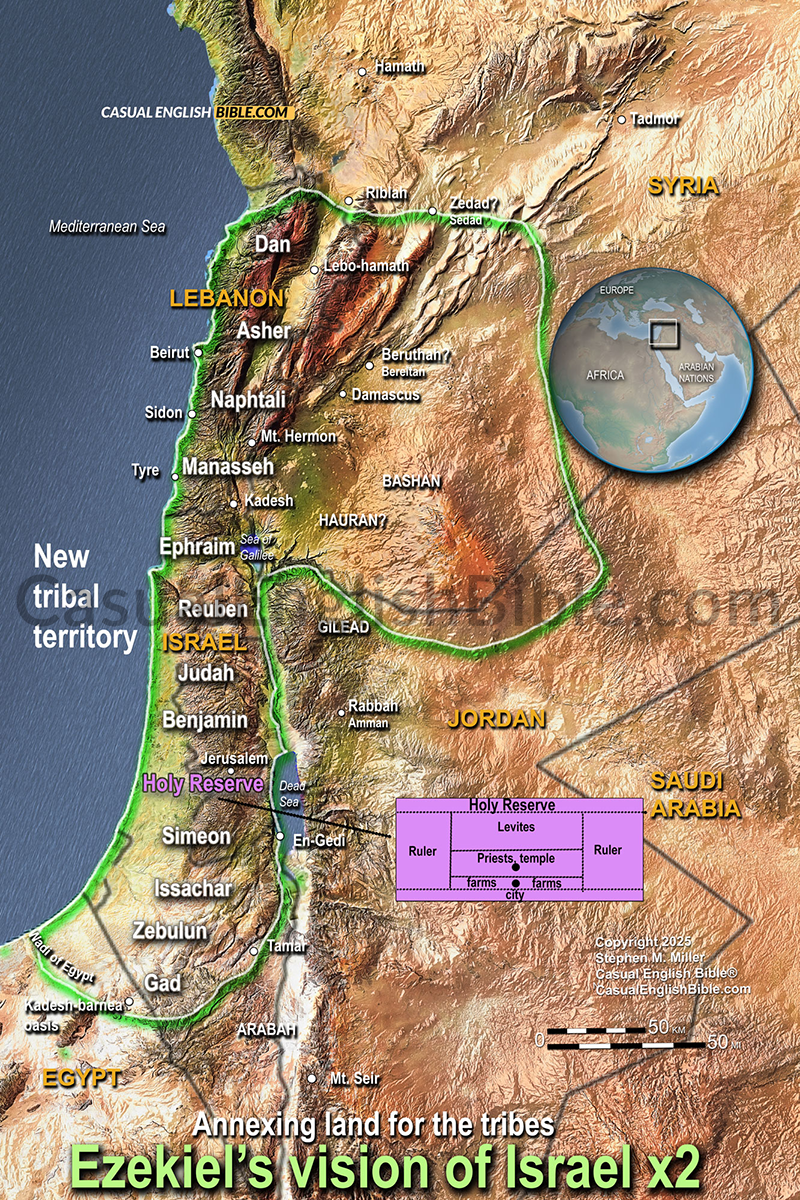
New, expanded Israel
Ezekiel sketches a fresh layout of tribal territory for Israel. He does this with worship in mind. He sets aside a rectangular “holy reserve” of land for the Lord—a central zone that includes space for the temple, for priests, and for Levites.
Think of it as a dedicated ministry district: the inner section for the sanctuary and serving priests; a matching section for the Levites who keep everything running; and, just south of that, a city zone with room for everyday life and workers who support the sacred complex. It’s all measured out in long cubits, emphasizing fairness and clarity, not guesswork.
The ruler's land
Flanking this holy center, to the east and west, lies the prince’s land. He doesn’t control the sanctuary—he surrounds it. That reshapes leadership: the prince protects worship rather than owning it. Ezekiel warns rulers against land grabs; the prince must not squeeze families off their property. Power is bounded so people can live in peace.
Honest business, honest worship
Right in the middle of these boundary notes, Ezekiel adds a reform: use honest weights, measures, and offerings. Borders and scales go together. In God’s vision, geography and justice align—fair lines on the map, fair dealings in the market, faithful offerings at the altar.
