
David united Israel and transformed it into the strongest kingdom in the region.
Through military victories and God's guidance, David secured Israel's borders and gained influence over many neighboring nations. His reign laid the foundation for the peaceful and prosperous kingdom that Solomon would later inherit.
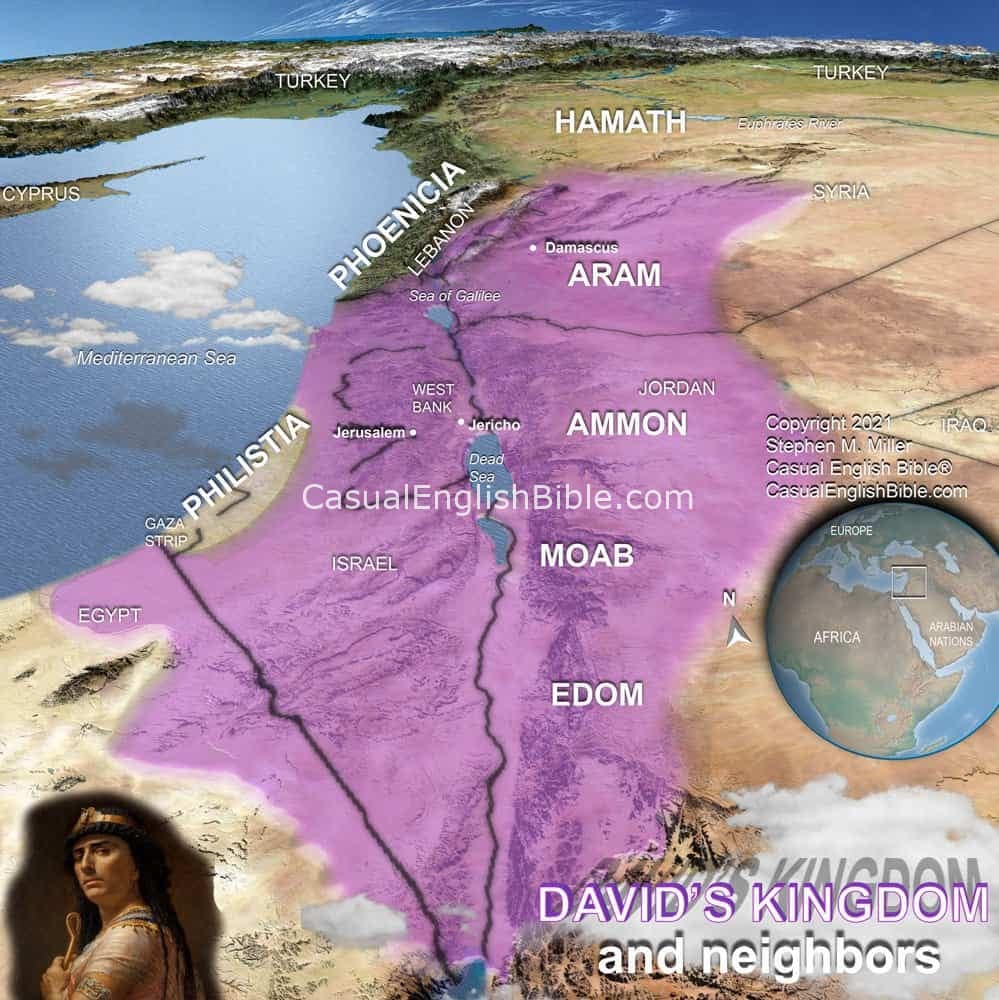
This map helps readers see David's expanding kingdom and the surrounding nations that shaped Israel's history.
David's Expanding Kingdom
David began as a shepherd and became Israel's greatest king. After uniting the twelve tribes, he established Jerusalem as the nation's capital and led successful campaigns against many neighboring enemies. His victories brought security to Israel and fulfilled many of God's promises to his people.
During David's reign, Israel interacted with powerful neighbors such as Philistia, Moab, Ammon, Edom, Aram, and Phoenicia. Some became enemies in battle, while others developed peaceful relationships that strengthened Israel's influence throughout the region. David's military success prepared the way for the stability and prosperity that characterized Solomon's reign.
The geography explains why these conflicts were so important. Israel sat between Egypt and the great kingdoms of Syria and Mesopotamia, with major trade routes crossing the land. Controlling the surrounding territory protected Jerusalem and gave Israel greater security and economic opportunity.
Understanding David's kingdom helps readers follow much of the history recorded in 1 and 2 Samuel and the opening chapters of 1 Kings. This map places David's reign in its geographical setting and shows how God established Israel as a leading nation during one of its greatest eras.
