
Revelation - Leaders Guide and Map Collection
Original price was: $49.00.$25.00Current price is: $25.00. SALE
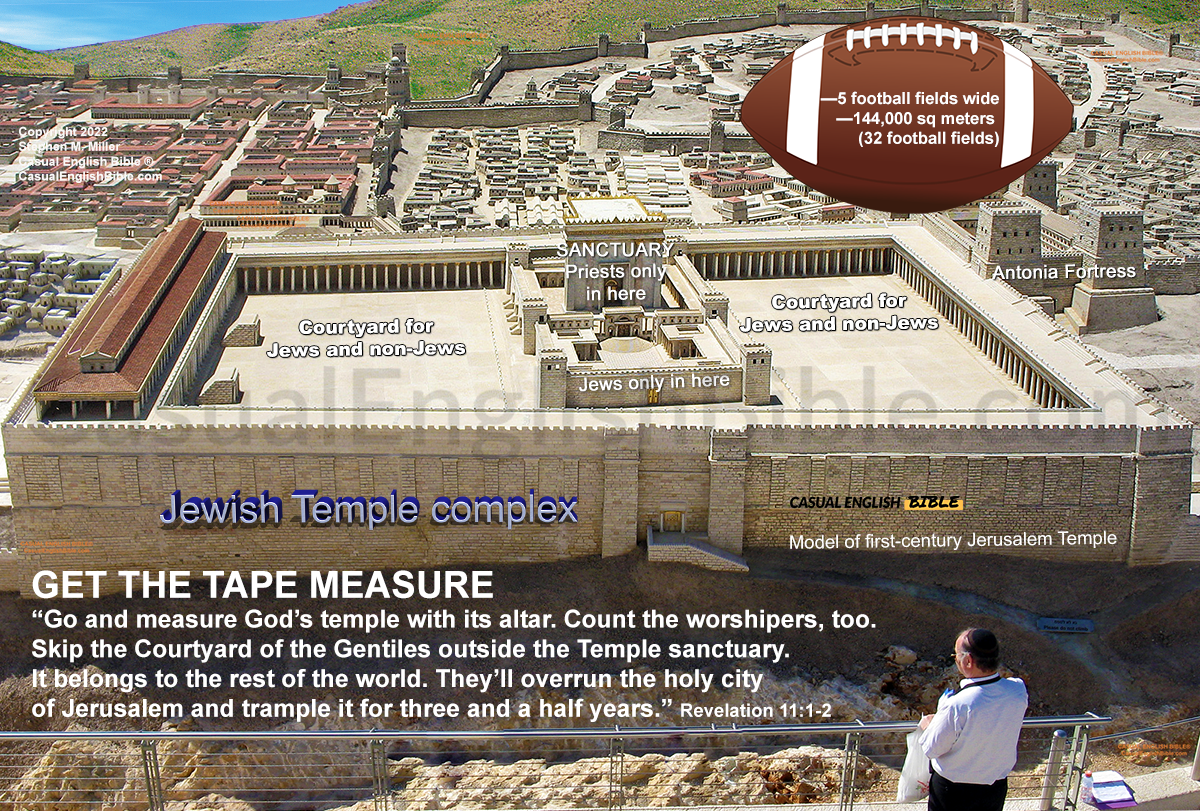
Temple in Jerusalem: how big was it?
$10.00
What you get
- A high-resolution map of the Jerusalem Temple complex in the time of Jesus
- Clear visual layout of courtyards, sanctuary areas, and surrounding structures
- Simple, memorable scale comparison using football fields
- Perfect for teaching, sermons, Bible study, or personal learning
- Available for immediate download
Description
Jerusalem Temple Complex
Stand on that platform and you’re not just looking at a building—you’re standing in the center of Jewish life for centuries. This is where people came to meet God, celebrate holidays, ask forgiveness, and make sense of life.
The original Temple goes back to King Solomon about 3,000 years ago. It was stunning—gold, bronze, cedar wood floated in from Lebanon. But what made it matter wasn’t the materials. It was what people believed happened there: this was where heaven and earth met.
By the time of Jesus, King Herod had rebuilt and massively expanded the Temple complex. What you see in this map is that later version—bigger, busier, and built to impress. Thousands of people could gather here at once. Priests worked the inner courts. Crowds filled the outer courtyards. And at the center sat the most sacred space of all.
The center of everything
The Temple wasn’t just a religious site. It was the heartbeat of the nation. People brought sacrifices, celebrated festivals, and learned what it meant to follow God. The closer you moved toward the center, the more restricted access became—until you reached the inner sanctuary, where only priests could go.
Gone—but not forgotten
This place was destroyed twice. The Babylonians leveled the first Temple in 586 BC. The rebuilt version—Herod’s Temple—stood until the Romans destroyed it in AD 70. After that, everything changed. Worship had to move beyond a place and into communities, which helped shape the synagogue system we know today.
Even now, the Temple still matters. It’s part of Jewish identity, history, and hope. And it sits at the center of one of the most contested pieces of land in the world.
Herod's Temple Mount Dimensions
The platform was roughly a trapezoid, not a perfect rectangle, but the approximate measurements are:
- South wall: ~280 meters (920 ft)
- North wall: ~315 meters (1,035 ft)
- East wall: ~460 meters (1,510 ft)
- West wall: ~485 meters (1,590 ft)
This wasn’t just a temple. It was a massive public space—part worship center, part gathering place, part national landmark.
What you get
- A high-resolution map of the Jerusalem Temple complex in the time of Jesus
- Clear visual layout of courtyards, sanctuary areas, and surrounding structures
- Simple, memorable scale comparison using football fields
- Perfect for teaching, sermons, Bible study, or personal learning
- Available for immediate download


Reviews
There are no reviews yet.