Three nations against Judah
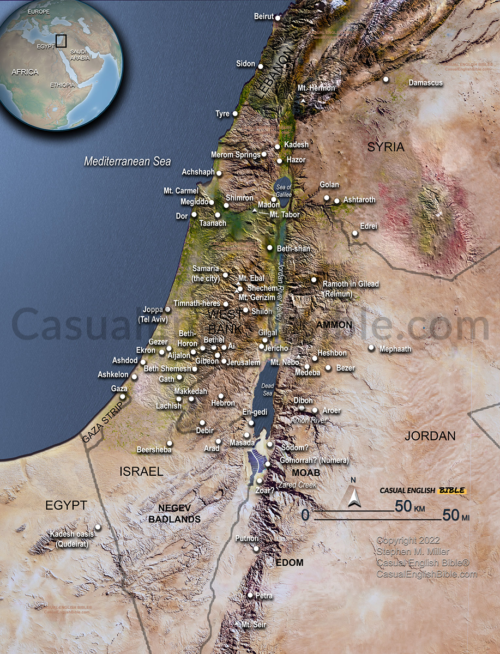
1Three nations declared war on King Jehoshaphat of Judah: Moab, Ammon, and the people of Mount Seir. [1]2Messengers delivered the bad news to Jehoshaphat. “A massive army is coming to you from Edom, east of the Dead Sea. They’re already at En-gedi.” [2] 3This terrified Jehoshaphat. He turned to the LORD for direction. He declared a nationwide fast. 4People from all over Judah came to Jerusalem to pray to God for help.
A king’s prayer for rescue
5King Jehoshaphat stood in front of the crowd gathered in the new courtyard at Jerusalem’s Temple.6He prayed, “Dear LORD, you’re the God of our ancestors. But you’re the God of heaven, too, aren’t you? And the God of everyone everywhere, right? You have more power than we could imagine. 7God, didn’t you drive out the people who used to live in this land? Didn’t you give it forever to your people, the descendants of Abraham, the man you loved?
8Your people lived here and built a Temple in your honor. 9They vowed, ‘If disaster comes—whether an army, a plague, or a famine—we will come to this sacred Temple and pray for help. For we know you will hear us and rescue us.’
10Look at these people coming at us from Ammon, Moab, and Mount Seir. When our people of Israel invaded this land, we avoided those nations instead of destroying them. 11Now this is how they thank us. They come to destroy us and take the land that you let us inherit.
12Please God, will you stop these invaders? We don’t have an army large enough to stop such an overwhelming force. We don’t know what to do but come to you.”
13All the crowd of Judah, including children and mothers with their babies, stood with the king as he prayed to the LORD.
God’s message: This battle is mine
14Then the LORD’s spirit inspired a man in the crowd to speak up. The man was a Levite associate of the priests and a descendant of the musician Asaph. His name was Jahaziel. He was the son of Zechariah, grandson of Benaiah, great-grandson of Jeiel, and great-great-grandson of Mattaniah.15Jahaziel said, “Listen to me people of Judah, citizens of Jerusalem, and King Jehoshaphat. This is the LORD’s message to you: ‘Don’t be afraid. Don’t be shocked at the size of this army of enemies. This isn’t your battle. This is my battle. I’ve got this. 16Tomorrow go down to face them. They will come to you, as well. They’ll make the climb at Ziz [3] and you’ll see them at the end of the valley there, by the Desert of Jeruel. [4] 17Don’t worry, my dear Jerusalem and Judah. You don’t have to fight. Just stand there and watch the LORD win the fight for you. Don’t be afraid. Don’t be shocked. Tomorrow go and face them. Remember that the LORD will be with you when you do.”
18At this message, Jehoshaphat bowed his face to the ground. The crowd did the same, and they all worshiped the LORD. 19Then two groups of Levite musicians from the family clans of Kohath and Korah started singing songs of praise to God. And they sang with gusto.
Musicians on the frontline
20The people of Judah got up early the next morning. They left Jerusalem and went south to the barren land near the town of Tekoa. Jehoshaphat spoke to them along the way. He said, “Listen to me people of Judah and citizens of Jerusalem. Believe the LORD your God and you’ll live. Trust what his prophets have said, and you’ll win.”21After consulting with his officials, Jehoshaphat selected a line of musicians who would march ahead of the army, singing praise songs about the LORD. [5] As they marched at the tip of the spear, they sang:
“The LORD is good to us.
Thank him for it.
He will never run out of mercy.” [6]
24When Judah reached the lookout tower in the desert near the battleground, they looked toward the enemy and saw nothing but corpses.
Robbing the dead
25Jehoshaphat and his people walked through the battlefield, collecting whatever valuables they could find. The invaders had brought a lot of livestock to feed the soldiers. They also brought equipment, clothing, and other valuables. People of Judah took three days to search the dead for the spoils of war. 26On the fourth day the people gathered there in what they named Grateful Valley. [8] The name stuck.27Jehoshaphat led the people back to Jerusalem. They were all joyfully celebrating that the LORD had saved them from the enemy. 28When they got to Jerusalem, they gathered at the Temple and brought out the harps, lyres, and ram’s horn trumpets.
29Nations throughout the region reacted to the news with fear. They grew terrified of God’s power when they heard he destroyed the invaders. 30Jehoshaphat’s kingdom enjoyed peace after that battle. No one else tried to attack them.
Jehoshaphat’s fleet sinks
1 Kings 22:41-50 31Jehoshaphat was 35 years old when he became king in Jerusalem. He reigned for 25 years. His mother was Azubah, the daughter of Shilhi. 32Jehoshaphat was his father’s son, Asa, and it showed. He stayed true to the LORD. 33He wasn’t able, however, to get rid of the hilltop shrines where people sacrificed animals to idols. The people weren’t devoted to the god of their ancestors.
34The rest of his story about his power and his wars is preserved in the writing of Jehu, which is included in the History of Israel’s Kings. [9]
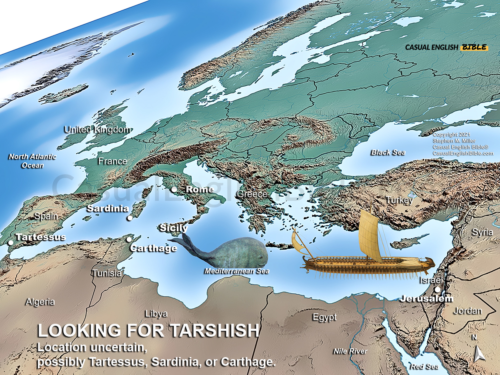
35Jehoshaphat made a peace treaty [10] with Israel’s wicked king, Ahaziah, son of King Ahab. 36They built ships together at the port of Ezion-geber, hoping to sail them to Tarshish. [11] 37But a prophet named Eliezer, son of Dodavahu from Mareshah, [12] warned Jehoshaphat, “The LORD is going to destroy those ships. He's going to do it because of the alliance you made with Ahaziah.” The ships never made it to Tarshish. They wrecked.
Related maps
31Jehoshaphat was 35 years old when he became king in Jerusalem. He reigned for 25 years. His mother was Azubah, the daughter of Shilhi. 32Jehoshaphat was his father’s son, Asa, and it showed. He stayed true to the LORD. 33He wasn’t able, however, to get rid of the hilltop shrines where people sacrificed animals to idols. The people weren’t devoted to the god of their ancestors.
34The rest of his story about his power and his wars is preserved in the writing of Jehu, which is included in the History of Israel’s Kings. [9]
35Jehoshaphat made a peace treaty [10] with Israel’s wicked king, Ahaziah, son of King Ahab. 36They built ships together at the port of Ezion-geber, hoping to sail them to Tarshish. [11] 37But a prophet named Eliezer, son of Dodavahu from Mareshah, [12] warned Jehoshaphat, “The LORD is going to destroy those ships. He's going to do it because of the alliance you made with Ahaziah.” The ships never made it to Tarshish. They wrecked.
34The rest of his story about his power and his wars is preserved in the writing of Jehu, which is included in the History of Israel’s Kings. [9]
35Jehoshaphat made a peace treaty [10] with Israel’s wicked king, Ahaziah, son of King Ahab. 36They built ships together at the port of Ezion-geber, hoping to sail them to Tarshish. [11] 37But a prophet named Eliezer, son of Dodavahu from Mareshah, [12] warned Jehoshaphat, “The LORD is going to destroy those ships. He's going to do it because of the alliance you made with Ahaziah.” The ships never made it to Tarshish. They wrecked.