Israel meets Shiloh
1The people of Israel met at Shiloh [1] and set up the tent worship center. 2Seven tribes still hadn’t captured their assigned land. 3Joshua told the people, “How long are you going to hang around and avoid doing what you know you have to do? You need to take the land that the LORD—the God of your ancestors—has already given you.Scouting Canaan again
4I want you to pick three men from each tribe. Send them on a scouting mission to survey the land. Then they’ll divide it among the seven tribes [2] that haven’t yet been assigned land. 5So, they’ll divide the land into seven sections. Judah will keep the southland territory it already has. So will Joseph’s two tribes [3] further north. 6When you finish writing the report, bring it to me. I’ll throw the dice [4] to determine who gets what, and I’ll do it with the LORD our God watching.7The tribe of Levi [5] won’t get any of this land. Neither will the tribes of Gad, Reuben, and half of Manasseh. They already got their land east of the Jordan River. Moses, God’s worker, gave it to them. 8So, the scouts headed out to do their job. Joshua sent them on their way with these orders: “Survey the remaining land here in the region and write up your report. When you’re done, bring it back and I’ll throw dice here at Shiloh. The LORD will oversee this.” 9The men traveled all over the countryside. They made notes about the towns they saw. And they divided the land into seven sections.
10Joshua threw the dice at Shiloh, with the LORD overseeing it all. Then Joshua distributed the land based on the roll of the dice.
Benjamin’s boundaries
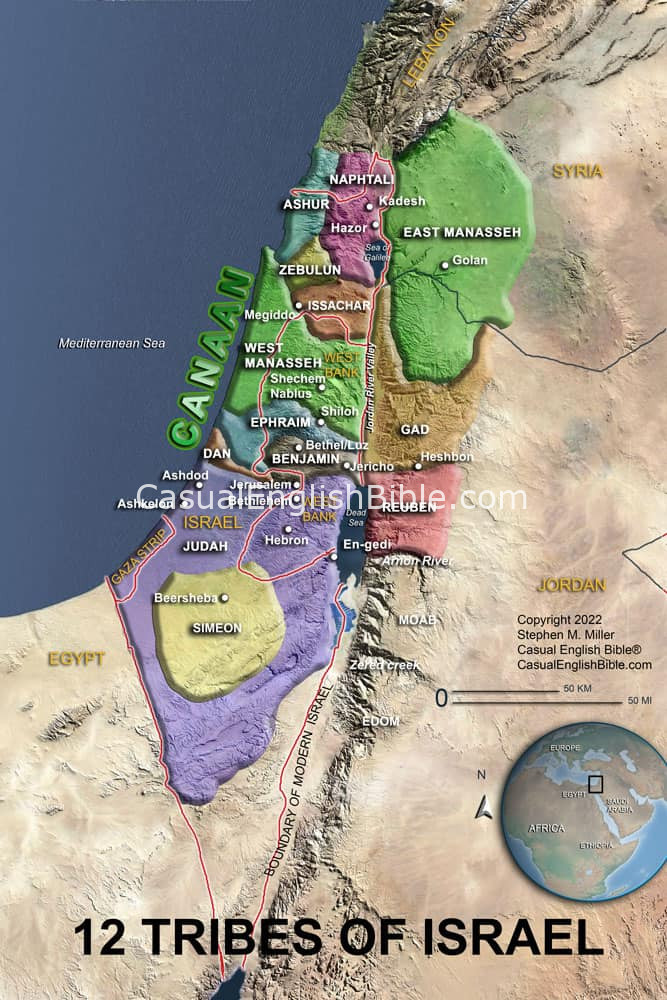
11The dice put Benjamin’s tribe on a plug of land between the tribe of Judah and the brother-tribes of Ephraim and Manasseh, descended from Joseph. 12Benjamin’s northern boundary started at the Jordan River and continued west along the north side of Jericho. It climbed into the hills and continued west to the fields of Beth-aven. 13From there, Benjamin’s western boundary drops south toward the hillside of Luz, also known as Bethel. The border continues dropping to Atroth-addar, on a hill south of Lower Beth-horon. 14The boundary curved onto the west side of the hill, then turned south along the south side of Beth-horon. It ended at Kiriath-baal, also known as Kiriath-jearim—a city in the tribe of Judah. That marked the extent of Benjamin’s western border.15Benjamin’s southern border started there, along the outskirts of Kiriath-jearim. From there, it continued east to Nephtoah spring. 16The boundary dropped to the foot of the hill at Ben Hinnom Valley, on the north side of the Valley of Rephaim. 17The boundary turned north and continued to En-shemesh, then on to Geliloth, across from Adummin Hill. Next, it went to the Stone of Bohan, named after a son of Reuben. 18The boundary continued along the northern hillsides above the Jordan River Valley, then down into the valley below. 19Then the boundary dropped to the northern part of Beth-hoglah and onto the northern shore of the Dead Sea, ending at the Jordan River. That is Benjamin’s southern border. 20The Jordan River marked their eastern border. This is the land given to families in the tribe of Benjamin.
Benjamin’s cities
21Here are the towns that fall within Benjamin’s territory:Beth-hoglah, Emek-keziz,
22Beth-arabah, Zemaraim, Bethel,
23Avvim, Parah, Ophrah,
24Chephar-ammoni, Ophni, and Geba.
That’s a total of 12 towns with their outlying villages.
25There’s more:
Gibeon, Ramah, Beeroth,
26Mizpeh, Chephirah, Mozah,
27Rekem, Irpeel, Taralah,
28Zela, Haeleph, Jebus (also called Jerusalem), Gibeah, and Kiriath-jearim.
That’s 14 towns with their villages, all of which belong to families living in Benjamin’s tribe.