Judah’s south boundary
1Israel used the random selection process of throwing dice [1] to assign land to the tribes. Families in Judah’s tribe drew a territory that reached as far south as the Zin Desert, [2] beside the land of Edom. 2The southern tip of the Dead Sea marks the beginning of Judah’s southern border. 3From there, it plunges south to Scorpion Pass. [3] It goes past the Zin Desert and the Kadesh-barnea oasis. It reaches the Hezron plain, climbs up to Addar, and curves around to Karka. 4It continues to Azmon. From there, the boundary runs along the Dry Creek of Egypt [5] until it reaches the Mediterranean Sea. That’s Judah’s southern boundary.East
5Judah’s eastern boundary runs along the banks of the Dead Sea, all the way north to where the Jordan River empties into the Dead Sea. Judah’s northern boundary starts there, too, where the river empties into the Dead Sea.North
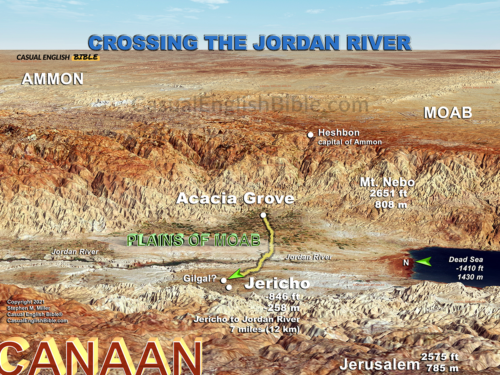
6The northern boundary follows a line along these locations:Beth-hoglah north of Beth-arabah and the Bohan Stone, named after Reuben’ son. 7It climbs out of Trouble Valley [5] and continues to Debir and then north to Gilgal. Gilgal faces Adummin Hill, which is south of the dry creek. It goes on the En-shemesh springs of water and to En-rogel. 8The boundary continues along the Son of Hinnom Valley. It doesn’t include Jerusalem, where Jebusites live. [6] The boundary runs along the Jerusalem hillside just south of the city. Then it climbs to the top of the hill on the west side of Hinnom Valley. That’s at the north end of the Valley of Rephaim.
9Judah’s northern boundary runs over to the Nephtoah spring and to the towns on Mount Ephron. It includes Baalah, a city also called Kiriath-jearim. 10The boundary continues west to Mount Seir. And it runs along the north hillside of Mount Jearim, also known as Chesalon, and then on to Beth-shemesh and to Timnah. 11From there, it continues to Ekron’s northern hill. Then it moves along to Shikkeron, Mount Baalah, Jabneel, and ends at the Mediterranean Sea.
West
12The Mediterranean Sea is Judah’s western boundary. So, these are the Judah’s boundaries. Families in Judah’s tribe live within these boundaries.Caleb gets a piece of Judah
13Joshua gave some of Judah’s land to Caleb, son of Jephunneh. [7] The LORD told him to. Caleb got the city of Hebron, which used to be called “Arba Town.” [8] Arba [9] was the father of Anak. [10] 14There were three family tribes living in Hebron before Caleb got there. Caleb ran them off: Sheshai, Ahiman, and Talmai. They were descendants of Anak. 15After that, Caleb targeted the nearby town of Debir, formerly called Kiriath-sepher.16He told his men, “Whoever captures this city gets to marry my daughter.” 17Caleb’s nephew, Othniel, led the assault that captured the city. Othniel was the son of Caleb’s brother, Kenaz. So, Othniel married his first cousin, Achsah. 18When the two got married, Achsah told her husband Othniel to ask her father for some land. Achsah later went to see her father. As she got off her donkey, Caleb asked her, “What’s wrong?” 19She said, “You gave us land in the Negev drylands. Would you give us one more thing? Could you give us some springs of water?” Caleb gave her two springs. One high and one low.
Cities in the south
20This land now belonged to families in the tribe of Judah. It became their new home. 21This is a list of the southland towns of Judah, in the Negev drylands near the border with Edom:Kabzeel, Eder, Jagur,
22Kinah, Dimonah, Adadah,
23Kedesh, Hazor, Ithnan,
24Ziph, Telem, Bealoth,
25Hazor-hadattah, Kerioth-hezron (that is, Hazor),
26Amam, Shema, Moladah,
27Hazar-gaddah, Heshmon, Beth-pelet,
28Hazar-shual, Beer-sheba, Biziothiah,
29Baalah, Iim, Ezem,
30Eltolad, Chesil, Hormah,
31Ziklag, Madmannah, Sansannah,
32Lebaoth, Shilhim, Ain, and Rimmon.
This totals 29 towns and their outlying villages and settlements.
Cities in the western hills
33Judah owned these cities in the western hill country:Eshtaol, Zorah, Ashnah,
34Zanoah, En-gannim, Tappuah, Enam,
35Jarmuth, Adullam, Socoh, Azekah,
36Shaaraim, Adithaim, Gederah, Gederothaim.
That’s 14 towns and outlying villages.
37But there’s more: Zenan, Hadashah, Migdal-gad,
38Dilan, Mizpeh, Jokthe-el,
39Lachish, Bozkath, Eglon,
40Cabbon, Lahmam, Chitlish,
41Gederoth, Beth-dagon, Naamah, and Makkedah.
That’s another 16 towns with their outlying villages.
42And there’s still more:
Libnah, Ether, Ashan,
43Iphtah, Ashnah, Nezib,
44Keilah, Achzib, and Mareshah.
That’s nine more towns and their villages.
45Judah also owned the city of Ekron and its villages, 46all the cities west of them. That includes Ashdod and villages, 47Gaza and villages, and everything from the Dry Creek of Egypt to the shores of the Mediterranean Sea.
Cities in the highlands
48In the highlands, Judah owned these cities:Shamir, Jattir, Socoh,
49Dannah, Kiriath-sannah, also known as Debir,
50Anab, Eshtemoh, Anim,
51Goshen, Holon, and Giloh.
That’s 11 highland towns with their outlying villages.
52And there’s more:
Arab, Dumah, Eshan,
53Janim, Beth-tappuah, Aphekah,
54Humtah, Kiriath-arba, also called Hebron, and Zior.
That’s nine more towns with their villages.
55There’s more:
Maon, Carmel, Ziph, Juttah,
56Jezreel, Jokdeam, Zanoah
57Kain, Gibeah, and Timnah.
That’s 10 towns with their villages.
58More highland towns:
Halhul, Beth-zur, Gedor,
59Maarath, Beth-anoth, and Eltekon.
That’s another six towns with their villages.
60Still more highland towns:
Kiriath-baal, also called Kiriath-jearim, and Rabbah.
That’s two more towns with their villages.
Cities in the wasteland
61Judah owned cities in the desert badlands:Beth-arabah, Middin, Secacah,
62Nibshan, the Salt City, and En-gedi.
That’s six towns with outlying communities.