Solomon preps to contact God
1 Kings 3:1-15 1King Solomon took firm control of his kingdom. The LORD God was on his side. That much was clear because Solomon kept getting stronger. [1]
2Solomon called a huge meeting of all the nation’s leaders: judges, family leaders, each commander of 1,000 men, and each commander of 100 men. He called in all the leaders. 3Solomon took the entire group to a hilltop in the neighboring town of Gibeon, [2] where priests in earlier times had set up the tent worship center. This was the famous Tabernacle that Moses established when Hebrew ancestors of the Israelites spent a generation in the barren [3] land. 4But the Box of Law that held the Ten Commandments wasn’t in that worship center anymore. Israelites stored it in the town of Kiriath-jearim until David brought it to Jerusalem and pitched a tent for it.
5Israel’s sacrificial altar stood outside the Gibeon tent. A bronzeworker made the altar from wood and plated it in bronze. His name was Bezalel, son of Uri and grandson of Hur. Solomon and Israel’s leaders went to the worship center to hear from God. 6Solomon walked over to the altar and began sacrificing 1,000 animals as burnt offerings [4] to God. Solomon’s big wish
7When Solomon went to sleep later that day, God appeared to him [5] and asked, “What would you like me to do for you?”
8Solomon told God, “You loved my father, David. And you’re still doing it because you’ve made a king out of his son. That’s why I sit on Israel’s throne today. 9I’d like you to carry through on the promises you made to my dad. You’ve already made me the king of a nation with so many people we couldn’t begin to count them all. We might as well count sand grains on the beach. 10So, what I need now is savvy—the wisdom it’ll take to lead this great nation. I especially need to be able to recognize the difference between right and wrong. LORD, who on earth could handle the job of governing all these people?”
11God told Solomon, “You didn’t ask for a long life or wealth. And thank you for not asking me to kill your enemies. Instead, you asked for the wisdom to know the difference between right and wrong. 12Well, I’m giving it to you now—wisdom in a bigger dose than I’ve given anyone before you or after. But there’s more. I’m giving you what you could have asked for but didn’t. You’re going to be richer and more respected than any other king around.”
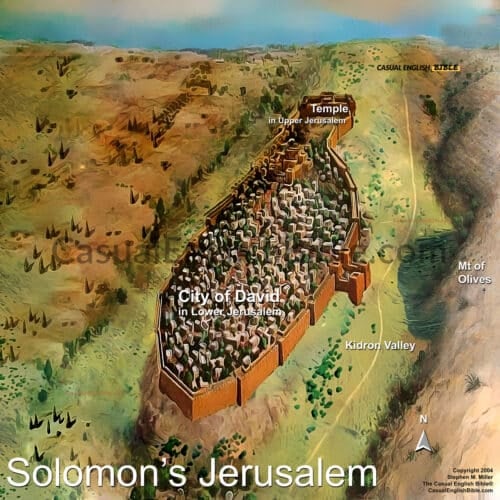
13Solomon left Gibeon’s hilltop worship center and returned to Jerusalem, the capital out of which he ruled Israel. Rich Solomon’s chariot corps 1 Kings 10:26-29 14Solomon established Israel’s cavalry and chariot corps. He had 1,400 chariots and 12,000 horses. He stationed them in Jerusalem and in towns scattered around the nation.
15For people visiting Jerusalem, silver seemed as common as stone. And imported cedar from Lebanon seemed as common as sycamore from the local Judean foothills.
16Solomon bought imported Turkish horses from the regions of Musri and Kue. [6] 17His merchants were also able to buy a chariot imported from Egypt for 15 pounds of silver. And they could buy a horse for about 4 pounds of silver. [7] Then they resold some of these to Hittite and Syrian kings.
Related maps
1King Solomon took firm control of his kingdom. The LORD God was on his side. That much was clear because Solomon kept getting stronger. [1]
2Solomon called a huge meeting of all the nation’s leaders: judges, family leaders, each commander of 1,000 men, and each commander of 100 men. He called in all the leaders. 3Solomon took the entire group to a hilltop in the neighboring town of Gibeon, [2] where priests in earlier times had set up the tent worship center. This was the famous Tabernacle that Moses established when Hebrew ancestors of the Israelites spent a generation in the barren [3] land. 4But the Box of Law that held the Ten Commandments wasn’t in that worship center anymore. Israelites stored it in the town of Kiriath-jearim until David brought it to Jerusalem and pitched a tent for it.
5Israel’s sacrificial altar stood outside the Gibeon tent. A bronzeworker made the altar from wood and plated it in bronze. His name was Bezalel, son of Uri and grandson of Hur. Solomon and Israel’s leaders went to the worship center to hear from God. 6Solomon walked over to the altar and began sacrificing 1,000 animals as burnt offerings [4] to God.
8Solomon told God, “You loved my father, David. And you’re still doing it because you’ve made a king out of his son. That’s why I sit on Israel’s throne today. 9I’d like you to carry through on the promises you made to my dad. You’ve already made me the king of a nation with so many people we couldn’t begin to count them all. We might as well count sand grains on the beach. 10So, what I need now is savvy—the wisdom it’ll take to lead this great nation. I especially need to be able to recognize the difference between right and wrong. LORD, who on earth could handle the job of governing all these people?”
11God told Solomon, “You didn’t ask for a long life or wealth. And thank you for not asking me to kill your enemies. Instead, you asked for the wisdom to know the difference between right and wrong. 12Well, I’m giving it to you now—wisdom in a bigger dose than I’ve given anyone before you or after. But there’s more. I’m giving you what you could have asked for but didn’t. You’re going to be richer and more respected than any other king around.”
13Solomon left Gibeon’s hilltop worship center and returned to Jerusalem, the capital out of which he ruled Israel.Rich Solomon’s chariot corps
2Solomon called a huge meeting of all the nation’s leaders: judges, family leaders, each commander of 1,000 men, and each commander of 100 men. He called in all the leaders. 3Solomon took the entire group to a hilltop in the neighboring town of Gibeon, [2] where priests in earlier times had set up the tent worship center. This was the famous Tabernacle that Moses established when Hebrew ancestors of the Israelites spent a generation in the barren [3] land. 4But the Box of Law that held the Ten Commandments wasn’t in that worship center anymore. Israelites stored it in the town of Kiriath-jearim until David brought it to Jerusalem and pitched a tent for it.
5Israel’s sacrificial altar stood outside the Gibeon tent. A bronzeworker made the altar from wood and plated it in bronze. His name was Bezalel, son of Uri and grandson of Hur. Solomon and Israel’s leaders went to the worship center to hear from God. 6Solomon walked over to the altar and began sacrificing 1,000 animals as burnt offerings [4] to God.
Solomon’s big wish
7When Solomon went to sleep later that day, God appeared to him [5] and asked, “What would you like me to do for you?”8Solomon told God, “You loved my father, David. And you’re still doing it because you’ve made a king out of his son. That’s why I sit on Israel’s throne today. 9I’d like you to carry through on the promises you made to my dad. You’ve already made me the king of a nation with so many people we couldn’t begin to count them all. We might as well count sand grains on the beach. 10So, what I need now is savvy—the wisdom it’ll take to lead this great nation. I especially need to be able to recognize the difference between right and wrong. LORD, who on earth could handle the job of governing all these people?”
11God told Solomon, “You didn’t ask for a long life or wealth. And thank you for not asking me to kill your enemies. Instead, you asked for the wisdom to know the difference between right and wrong. 12Well, I’m giving it to you now—wisdom in a bigger dose than I’ve given anyone before you or after. But there’s more. I’m giving you what you could have asked for but didn’t. You’re going to be richer and more respected than any other king around.”
13Solomon left Gibeon’s hilltop worship center and returned to Jerusalem, the capital out of which he ruled Israel.
Rich Solomon’s chariot corps 1 Kings 10:26-29 14Solomon established Israel’s cavalry and chariot corps. He had 1,400 chariots and 12,000 horses. He stationed them in Jerusalem and in towns scattered around the nation.
15For people visiting Jerusalem, silver seemed as common as stone. And imported cedar from Lebanon seemed as common as sycamore from the local Judean foothills.
16Solomon bought imported Turkish horses from the regions of Musri and Kue. [6] 17His merchants were also able to buy a chariot imported from Egypt for 15 pounds of silver. And they could buy a horse for about 4 pounds of silver. [7] Then they resold some of these to Hittite and Syrian kings.
15For people visiting Jerusalem, silver seemed as common as stone. And imported cedar from Lebanon seemed as common as sycamore from the local Judean foothills.
16Solomon bought imported Turkish horses from the regions of Musri and Kue. [6] 17His merchants were also able to buy a chariot imported from Egypt for 15 pounds of silver. And they could buy a horse for about 4 pounds of silver. [7] Then they resold some of these to Hittite and Syrian kings.