Home of the Lebanon Forest
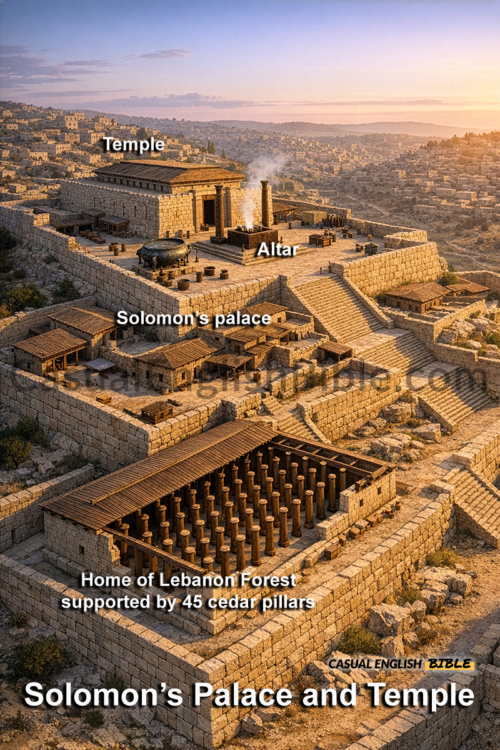
1It took 13 years to build Solomon’s palace. [1] 2“Home of the Lebanon Forest” [2] was largest room in the palace. Builders erected cedar pillars everywhere. They shaped the room into a huge rectangle around three rows of cedar pillars, 15 pillars in each row. That totaled 45 pillars. The room measured 50 yards long, 25 yards wide, and 15 yards high. [3]3For a roof, builders put 45 rafters—huge beams—across the tops of all 45 pillars. Then they covered the rafters with cedar. 4Builders cut three rows of windows on each side of the room, with them facing each other. [4] Workers cut three doorways on each side, close to the entrance at the front of the room. 5They framed all the doorways with four-sided posts and placed the doorways across from each other.
Pillar Hall and Justice Hall
6Solomon built a room called Pillar Hall. He laid it out 25 yards long by 15 yards wide. [5] Then he added a front porch with pillars supporting a roof. 7He paneled the courthouse, Justice Hall, entirely of cedar—from floor to ceiling. This is where he would judge court cases.8Solomon ordered his house built behind Justice Hall, and along the same design. He followed that pattern, too, for the home of his Egyptian bride, Pharaoh’s daughter. 9All these buildings were made of cut stone, chiseled, and sawed to fit.
10For the foundation of each building, stonecutters harvested expensive stone and cut it into blocks either 15 feet long or 12 feet. [6] 11Stoneworkers did the same for the walls—building them with expensive, quarried stone. Carpenters paneled them in cedar.
12Workers built walls around the entire palace complex—three rows of cut stone and a layer of cedar beams. They did the same for the walls around the inner courtyard of the Temple.
Hiram makes all things bronze
2 Chronicles 3:15-17; 4:1-10 13King Solomon invited a man named Hiram, [7] from Tyre, to come down and see him. 14Hiram was half Israelite. His widowed mother came from the northern tribe of Naphtali. His late father had been an intelligent man and an expert bronze worker. Hiram became gifted in bronze work, too. He agreed to oversee all the bronze work Solomon needed.
15Hiram used clay molds to cast two bronze pillars, each 27 feet tall and almost six feet thick. It took 18 feet of rope to wrap the pillar once—the circumference. [8] 16He topped those pillars with bronze capitals more than seven feet tall. [9] 17He decorated each capital with a design that looked like seven chains woven into the form of nets. 18He added two rows of pomegranate art.
19For the two pillars in the entryway, out on the front porch, he topped them with capitals shaped like water lilies six feet tall. [10] 20He added two rows of pomegranate images around the top of each pillar, just below the capitals—200 pomegranates for each pillar. Temple’s twin bronze pillars
21Hiram made two huge pillars for the front porch of the Temple sanctuary. He named the pillar on the south side of the entrance Jachin. The one on the north side became Boaz. 22He designed pictures of lilies for the top of those pillars. Then, the bronze pillars were done.
23Hiram also made a massive bronze bowl 15 feet across, over seven feet deep, and 45 feet around the rim’s circumference. They called this bowl the Sea. [11] 24Just below the outside rim of the bowl, Hiram added two rows of bronze gourds—about six gourds for every foot. [12] He cast them as part of the bowl instead of adding them later. 25He mounted the bowl on the backs of 12 bronze bulls—three facing outwards in each direction, north, south, east, and west.
26The metal of the bowl was as thick as a man’s hand is wide, about three inches. [13] The brim looked like an open lily, with the rim curving outward. It held 11,000 gallons. [14] Hiram’s traveling water carts
27To transport water, Hiram mounted 10 bronze tubs onto bronze carts. The water carts were about six feet long and wide, and over four feet high. [15] 28Hiram built the carts on a frame of crossbars enclosed by decorated side panels. 29Hiram decorated the panels and frame with pictures of wreaths, lions, bulls, and winged cherubim.
30He mounted each cart onto a lower chassis frame of four bronze wheels, two axels, along with rods connecting the wheels to the bottom of the carriage above. He decorated the connecting rods with pictures of wreaths cast into the metal. 31The carriage that held the bronze bowl of water was round at the top. It had a frame 18 inches [16]high. That held the bowl in place. The bowl was round and more than two feet wide. The cart, however, was square with bronze designs cast into the metal. Cart on wheels
32The wheels were 27 inches high. [17] They revolved around axels that Hiram cast as part of the cart. 33The wheels were designed to look like they belonged on a chariot. They had the whole package, axles, rims, spokes, and hubcaps—all of it made from bronze.
34Hiram added four handles at the top of the cart, one in each corner. They, too, were cast from the mold that produced the cart. 35At the top of the cart Hiram added a rim of designer bronze nine inches wide. [18] He cast it as a solid part of the cart. 36Side panels on the cart looked like bronze murals, with images cast directly into the metal: winged cherubim, lions, palm trees, and flowers—all of it laced in wreath designs.
37Hiram made 10 of these portable water carts, all of them alike. 38He also made 10 bronze bowls to go inside the carts. Each bowl held 220 gallons [19] of water.
39The huge reservoir of water, a bronze bowl called the Sea, sat near the southeast corner of the Temple complex. Hiram placed five bowls and their carts on the south side of the Temple, and five on the north. Hiram, still on the job
2 Chronicles 4:11-5:1 40Hiram made utensils for the sacrifice rituals, too: pots, shovels, and small bowls. With that, he finished everything he needed to do for the Temple of the LORD. 41Here’s what Hiram made for the Temple:
Two huge pillars
Two bowl-shaped capitals on top of the pillars
Two designs, one for each column: the look of chains woven into nets
42Four hundred pomegranates below the capitals, 200 on each pillar
43Ten mobile water reservoirs mounted in carts
44The large reservoir called the Sea, mounted on a dozen bronze bulls
45All the bronze utensils for the Temple, including pots, shovels, and small bowls. From Jordan River mud to bronze
46The king had Hiram cast all this bronze work in molds made from the Jordan River Valley clay found between the towns of Succoth and Zarethan. [20] 47Solomon didn’t bother to document the weight of all this bronze. There was too much to weigh.
48In addition to ordering bronze work for the Temple, Solomon ordered all the other furnishings used inside:
Golden altar
Golden table for sacred bread representing God’s presence with Israel
49Golden lampstands for light inside the Temple. Priests put five on the south side and five on the north. This was just in front of the Most Holy Place, where the Ten Commandments were kept.
Flower arrangements
Gold lamps
Gold tongs for holding hot coals
50Small golden bowls
Golden lamp snuffers to put out the lamplight
Golden incense burners
Doors, overlaid with gold, leading into the main sanctuary and into the Most Holy Place 51Solomon finished building the Temple. Then Solomon collected all the riches David had accumulated and set it aside for the future Temple. Then he moved them into the Temple treasury.
Related maps
13King Solomon invited a man named Hiram, [7] from Tyre, to come down and see him. 14Hiram was half Israelite. His widowed mother came from the northern tribe of Naphtali. His late father had been an intelligent man and an expert bronze worker. Hiram became gifted in bronze work, too. He agreed to oversee all the bronze work Solomon needed.
15Hiram used clay molds to cast two bronze pillars, each 27 feet tall and almost six feet thick. It took 18 feet of rope to wrap the pillar once—the circumference. [8] 16He topped those pillars with bronze capitals more than seven feet tall. [9] 17He decorated each capital with a design that looked like seven chains woven into the form of nets. 18He added two rows of pomegranate art.
19For the two pillars in the entryway, out on the front porch, he topped them with capitals shaped like water lilies six feet tall. [10] 20He added two rows of pomegranate images around the top of each pillar, just below the capitals—200 pomegranates for each pillar.
23Hiram also made a massive bronze bowl 15 feet across, over seven feet deep, and 45 feet around the rim’s circumference. They called this bowl the Sea. [11] 24Just below the outside rim of the bowl, Hiram added two rows of bronze gourds—about six gourds for every foot. [12] He cast them as part of the bowl instead of adding them later. 25He mounted the bowl on the backs of 12 bronze bulls—three facing outwards in each direction, north, south, east, and west.
26The metal of the bowl was as thick as a man’s hand is wide, about three inches. [13] The brim looked like an open lily, with the rim curving outward. It held 11,000 gallons. [14]
30He mounted each cart onto a lower chassis frame of four bronze wheels, two axels, along with rods connecting the wheels to the bottom of the carriage above. He decorated the connecting rods with pictures of wreaths cast into the metal. 31The carriage that held the bronze bowl of water was round at the top. It had a frame 18 inches [16]high. That held the bowl in place. The bowl was round and more than two feet wide. The cart, however, was square with bronze designs cast into the metal.
34Hiram added four handles at the top of the cart, one in each corner. They, too, were cast from the mold that produced the cart. 35At the top of the cart Hiram added a rim of designer bronze nine inches wide. [18] He cast it as a solid part of the cart. 36Side panels on the cart looked like bronze murals, with images cast directly into the metal: winged cherubim, lions, palm trees, and flowers—all of it laced in wreath designs.
37Hiram made 10 of these portable water carts, all of them alike. 38He also made 10 bronze bowls to go inside the carts. Each bowl held 220 gallons [19] of water.
39The huge reservoir of water, a bronze bowl called the Sea, sat near the southeast corner of the Temple complex. Hiram placed five bowls and their carts on the south side of the Temple, and five on the north.Hiram, still on the job
15Hiram used clay molds to cast two bronze pillars, each 27 feet tall and almost six feet thick. It took 18 feet of rope to wrap the pillar once—the circumference. [8] 16He topped those pillars with bronze capitals more than seven feet tall. [9] 17He decorated each capital with a design that looked like seven chains woven into the form of nets. 18He added two rows of pomegranate art.
19For the two pillars in the entryway, out on the front porch, he topped them with capitals shaped like water lilies six feet tall. [10] 20He added two rows of pomegranate images around the top of each pillar, just below the capitals—200 pomegranates for each pillar.
Temple’s twin bronze pillars
21Hiram made two huge pillars for the front porch of the Temple sanctuary. He named the pillar on the south side of the entrance Jachin. The one on the north side became Boaz. 22He designed pictures of lilies for the top of those pillars. Then, the bronze pillars were done.23Hiram also made a massive bronze bowl 15 feet across, over seven feet deep, and 45 feet around the rim’s circumference. They called this bowl the Sea. [11] 24Just below the outside rim of the bowl, Hiram added two rows of bronze gourds—about six gourds for every foot. [12] He cast them as part of the bowl instead of adding them later. 25He mounted the bowl on the backs of 12 bronze bulls—three facing outwards in each direction, north, south, east, and west.
26The metal of the bowl was as thick as a man’s hand is wide, about three inches. [13] The brim looked like an open lily, with the rim curving outward. It held 11,000 gallons. [14]
Hiram’s traveling water carts
27To transport water, Hiram mounted 10 bronze tubs onto bronze carts. The water carts were about six feet long and wide, and over four feet high. [15] 28Hiram built the carts on a frame of crossbars enclosed by decorated side panels. 29Hiram decorated the panels and frame with pictures of wreaths, lions, bulls, and winged cherubim.30He mounted each cart onto a lower chassis frame of four bronze wheels, two axels, along with rods connecting the wheels to the bottom of the carriage above. He decorated the connecting rods with pictures of wreaths cast into the metal. 31The carriage that held the bronze bowl of water was round at the top. It had a frame 18 inches [16]high. That held the bowl in place. The bowl was round and more than two feet wide. The cart, however, was square with bronze designs cast into the metal.
Cart on wheels
32The wheels were 27 inches high. [17] They revolved around axels that Hiram cast as part of the cart. 33The wheels were designed to look like they belonged on a chariot. They had the whole package, axles, rims, spokes, and hubcaps—all of it made from bronze.34Hiram added four handles at the top of the cart, one in each corner. They, too, were cast from the mold that produced the cart. 35At the top of the cart Hiram added a rim of designer bronze nine inches wide. [18] He cast it as a solid part of the cart. 36Side panels on the cart looked like bronze murals, with images cast directly into the metal: winged cherubim, lions, palm trees, and flowers—all of it laced in wreath designs.
37Hiram made 10 of these portable water carts, all of them alike. 38He also made 10 bronze bowls to go inside the carts. Each bowl held 220 gallons [19] of water.
39The huge reservoir of water, a bronze bowl called the Sea, sat near the southeast corner of the Temple complex. Hiram placed five bowls and their carts on the south side of the Temple, and five on the north.
Hiram, still on the job
2 Chronicles 4:11-5:1 40Hiram made utensils for the sacrifice rituals, too: pots, shovels, and small bowls. With that, he finished everything he needed to do for the Temple of the LORD. 41Here’s what Hiram made for the Temple:
Two huge pillars
Two bowl-shaped capitals on top of the pillars
Two designs, one for each column: the look of chains woven into nets
42Four hundred pomegranates below the capitals, 200 on each pillar
43Ten mobile water reservoirs mounted in carts
44The large reservoir called the Sea, mounted on a dozen bronze bulls
45All the bronze utensils for the Temple, including pots, shovels, and small bowls. From Jordan River mud to bronze
46The king had Hiram cast all this bronze work in molds made from the Jordan River Valley clay found between the towns of Succoth and Zarethan. [20] 47Solomon didn’t bother to document the weight of all this bronze. There was too much to weigh.
48In addition to ordering bronze work for the Temple, Solomon ordered all the other furnishings used inside:
Golden altar
Golden table for sacred bread representing God’s presence with Israel
49Golden lampstands for light inside the Temple. Priests put five on the south side and five on the north. This was just in front of the Most Holy Place, where the Ten Commandments were kept.
Flower arrangements
Gold lamps
Gold tongs for holding hot coals
50Small golden bowls
Golden lamp snuffers to put out the lamplight
Golden incense burners
Doors, overlaid with gold, leading into the main sanctuary and into the Most Holy Place 51Solomon finished building the Temple. Then Solomon collected all the riches David had accumulated and set it aside for the future Temple. Then he moved them into the Temple treasury.
Related maps
40Hiram made utensils for the sacrifice rituals, too: pots, shovels, and small bowls. With that, he finished everything he needed to do for the Temple of the LORD. 41Here’s what Hiram made for the Temple:
43Ten mobile water reservoirs mounted in carts
44The large reservoir called the Sea, mounted on a dozen bronze bulls
45All the bronze utensils for the Temple, including pots, shovels, and small bowls.
48In addition to ordering bronze work for the Temple, Solomon ordered all the other furnishings used inside:
Flower arrangements
Gold lamps
Gold tongs for holding hot coals
50Small golden bowls
Golden lamp snuffers to put out the lamplight
Golden incense burners
Doors, overlaid with gold, leading into the main sanctuary and into the Most Holy Place 51Solomon finished building the Temple. Then Solomon collected all the riches David had accumulated and set it aside for the future Temple. Then he moved them into the Temple treasury.
Two huge pillars
Two bowl-shaped capitals on top of the pillars
Two designs, one for each column: the look of chains woven into nets
43Ten mobile water reservoirs mounted in carts
44The large reservoir called the Sea, mounted on a dozen bronze bulls
45All the bronze utensils for the Temple, including pots, shovels, and small bowls.
From Jordan River mud to bronze
46The king had Hiram cast all this bronze work in molds made from the Jordan River Valley clay found between the towns of Succoth and Zarethan. [20] 47Solomon didn’t bother to document the weight of all this bronze. There was too much to weigh.48In addition to ordering bronze work for the Temple, Solomon ordered all the other furnishings used inside:
Golden altar
Golden table for sacred bread representing God’s presence with Israel
Flower arrangements
Gold lamps
Gold tongs for holding hot coals
50Small golden bowls
Golden lamp snuffers to put out the lamplight
Golden incense burners
Doors, overlaid with gold, leading into the main sanctuary and into the Most Holy Place 51Solomon finished building the Temple. Then Solomon collected all the riches David had accumulated and set it aside for the future Temple. Then he moved them into the Temple treasury.